Bonsailist
SpeciesCategoriesGuidesQuestionsToolsStylesAbout
Bonsailist

The field guide for your first bonsai — care with real numbers, honest species picks, and tools that do the math for you.

Browse

  • All Species
  • Categories
  • Bonsai Styles
  • Compare Species

Learn

  • Care Guides
  • Bonsai Tools
  • Common Questions
  • Best For
  • Climate Zones

About

  • About Us
  • Sitemap
© 2026 BonsaiList. All rights reserved.
Privacy PolicyTerms of ServiceAccessibility
  1. Home
  2. /
  3. Guides
  4. /
  5. Winter Care for Bonsai Trees
Field guide

Winter Care for Bonsai Trees

Outdoor bonsai need winter cold for dormancy, but shallow pots leave roots dangerously exposed to freezing. Protection is straightforward once you know the options.

On the benchmulch or strawcold framefrost cloththermometergrow lights (for tropical species)

On this page

  1. The two-zone rule: why the pot is the problem
  2. Tropicals come in, temperate trees stay out
  3. The winter calendar: shutdown, deep winter, release
  4. Zones 6 and warmer: mulch the pots
  5. Zones 3-5: unheated garage, shed, or cold frame
  6. No yard? Overwintering on a balcony
  7. What actually kills trees in winter storage
  8. Winter by species
  9. Quick winter sheet

Most outdoor bonsai are tougher than their owners give them credit for. A juniper that laughs off -20°F in the ground isn't suddenly fragile because you put it in a ceramic pot. The tree is fine. The problem is the pot: in the ground, roots sit insulated by a massive volume of earth; in a bonsai container, there's barely an inch of soil between living roots and freezing air on every side. Protect the roots and the tree handles the rest.

The two-zone rule: why the pot is the problem

Tops and roots have different cold limits, and the gap is bigger than most beginners guess. Trunk and branches harden off in fall and take brutal cold; roots never harden the same way. Juniper foliage shrugs at -20°F while juniper roots start taking damage around 15-17°F. Maple roots are more tender still — damage starts in the mid-20s.
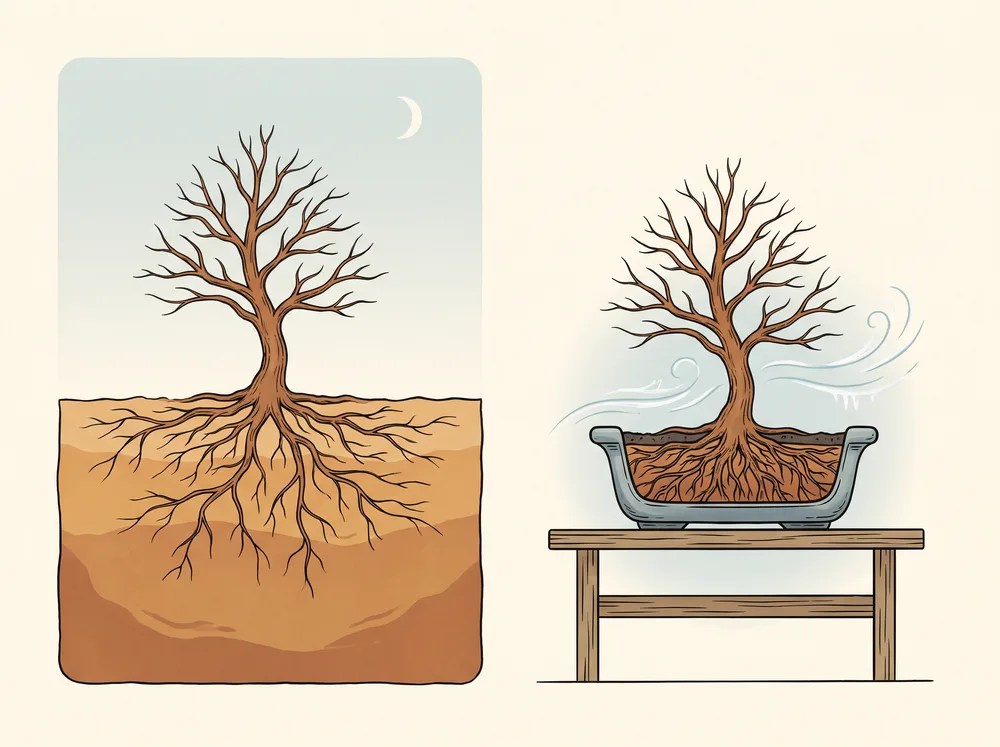
Cutaway illustration comparing a tree's roots insulated deep in open ground with the same tree's roots exposed in a shallow bonsai pot on a bench.
Same species, same cold snap. In the ground, roots sit under a duvet of earth; in a pot, about an inch of soil separates them from freezing air on every side. That gap is the whole two-zone rule.

The working shortcut: a potted tree loses roughly two zones of hardiness versus the same species in the ground. A tree rated for zone 4 in the ground is only a safe unprotected zone 6 tree in a bonsai pot.

The target: hold the root zone at 25-45°F all winter. Roots die below that band; above it, no real dormancy. Every strategy below is a different way of hitting that range.

Tropicals come in, temperate trees stay out

Overwinter plannerspecies + zone
Your species
Your USDA zone · not sure?

Sort your trees first — the two groups have opposite winters.

Tropicals can't take frost. Ficus, jade, Fukien tea, and schefflera come inside before nights dip below 50°F. Give them your brightest window or a grow light running 12-14 hours, add a humidity tray, and expect a downshift: indoor winter light is a fraction of summer sun, so growth slows or stalls, the soil dries more slowly, and you water less often. A few yellowed leaves after the move are adjustment, not decline; if it goes beyond that, start with why is my bonsai dropping leaves. Full setup in the indoor growing guide.

Temperate trees stay out — yes, even in snow. Japanese maples, junipers, pines, and larches need eight to fourteen weeks below 45°F to complete their dormancy cycle. Skip it and the tree emerges in actual spring exhausted — and weaker every year it happens.

Never

Never overwinter a temperate bonsai in a heated room — the warmth registers as spring, breaks dormancy, and forces growth the tree can't sustain under indoor light, burning reserves it needed for the real spring.

One November panic worth preempting: deciduous bonsai drop every leaf in fall. A bare maple, elm, or hornbeam is a healthy tree doing what it should.

The winter calendar: shutdown, deep winter, release

Shutdown (roughly October through the first hard freezes). Ease off nitrogen from late summer so the year's growth hardens naturally — details in the fertilizing guide. Finish wiring and pruning by early October, remove any wire that could bite in during months of fewer checks, and confirm every pot drains freely; standing water that freezes is a guaranteed cracked pot. Then wait — the first light frosts in the 28-32°F range are part of the hardening process.
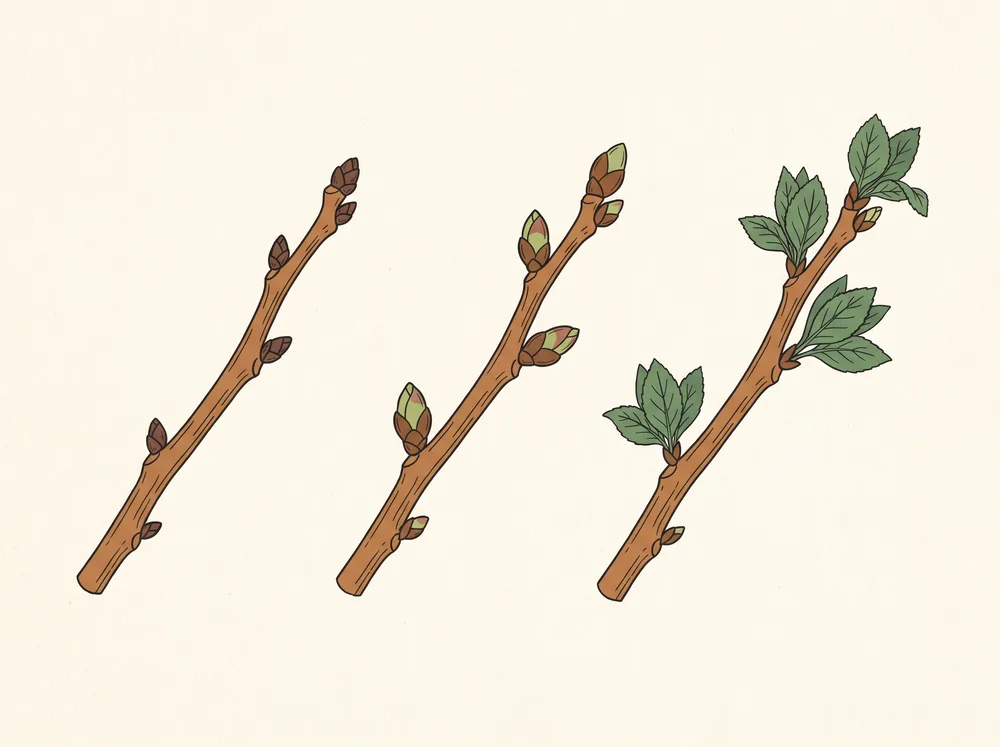
Field-guide illustration of three twigs showing tight dormant buds, swollen buds shifting color, and newly opened leaves.
Left to right: hold, get ready, release. Tight buds — leave the tree tucked in. Fattening buds shifting color — start opening things up over a week or two. Open leaves — frost cloth stays within arm's reach until your last-frost date has passed.

Bench rule

Don't tuck trees into winter protection until they've taken two or three hard frosts and deciduous species have dropped their leaves — protecting too early keeps them warm enough to stall dormancy.

For most growers in zones 5-7, full protection starts in November, not September.

Deep winter (December-February). Check garaged and cold-framed trees monthly, balcony trees weekly. Dormant trees use almost nothing, but they can't use zero: if the soil is dry a finger-depth down and temperatures are above freezing, water lightly — technique in the watering guide.

Bench rule

Water only unfrozen soil, only on above-freezing days, and never right before a hard freeze — expanding ice cracks even good pots.

The February trap is a false spring. A week of 60°F can wake trees early, and buds that open in February have no defense against March. When a warm spell hits, leave the trees where they are — cold side, shaded.

Release (bud swell, usually March into April). When buds fatten and shift color, open things up gradually: pull mulch back over a week or two, move trees out of the frame on mild days. New growth has none of winter's hardiness — one 26°F April night kills a maple's fresh flush outright — so keep frost cloth handy until your last-frost date has actually passed.

Zones 6 and warmer: mulch the pots

If you garden in zone 6 or warmer, set your bonsai on the ground in a sheltered spot and mulch over the pots. The north side of a building or a solid fence is ideal — it blocks direct winter sun, which prevents the freeze-thaw cycles where soil thaws by day and refreezes at night, and it cuts the drying wind that punishes evergreens. Mound leaves, straw, or bark mulch up and over the pots until the soil surface is buried. Done. The tree gets its natural cold while the roots stay insulated.

Zones 3-5: unheated garage, shed, or cold frame

Colder climates need walls. An unheated garage or garden shed is the standard solution for zone 5 and below: you want 25-45°F — cold enough to hold dormancy, warm enough that root balls don't freeze into solid ice. An attached garage on a heated house often lands in this range naturally. A dark garage is fine for leafless deciduous trees; evergreens do better near a window — growers disagree on how much light a dormant evergreen needs, but none argue it needs warmth.

A cold frame is the gold standard, worth building if you have more than a few trees. Size it to your collection, place it out of direct afternoon sun (a greenhouse effect in January is exactly what you don't want), and pack the trees inside. Crack the lid on sunny days to vent heat; drape a blanket or foam board over it on the coldest nights. Roots hold safely in the 25-40°F range with almost no daily effort. An unheated greenhouse is the same idea at walk-in scale; a heated one is tropical housing.

No yard? Overwintering on a balcony

Apartment growers can absolutely keep outdoor bonsai. The balcony just needs a little setup:
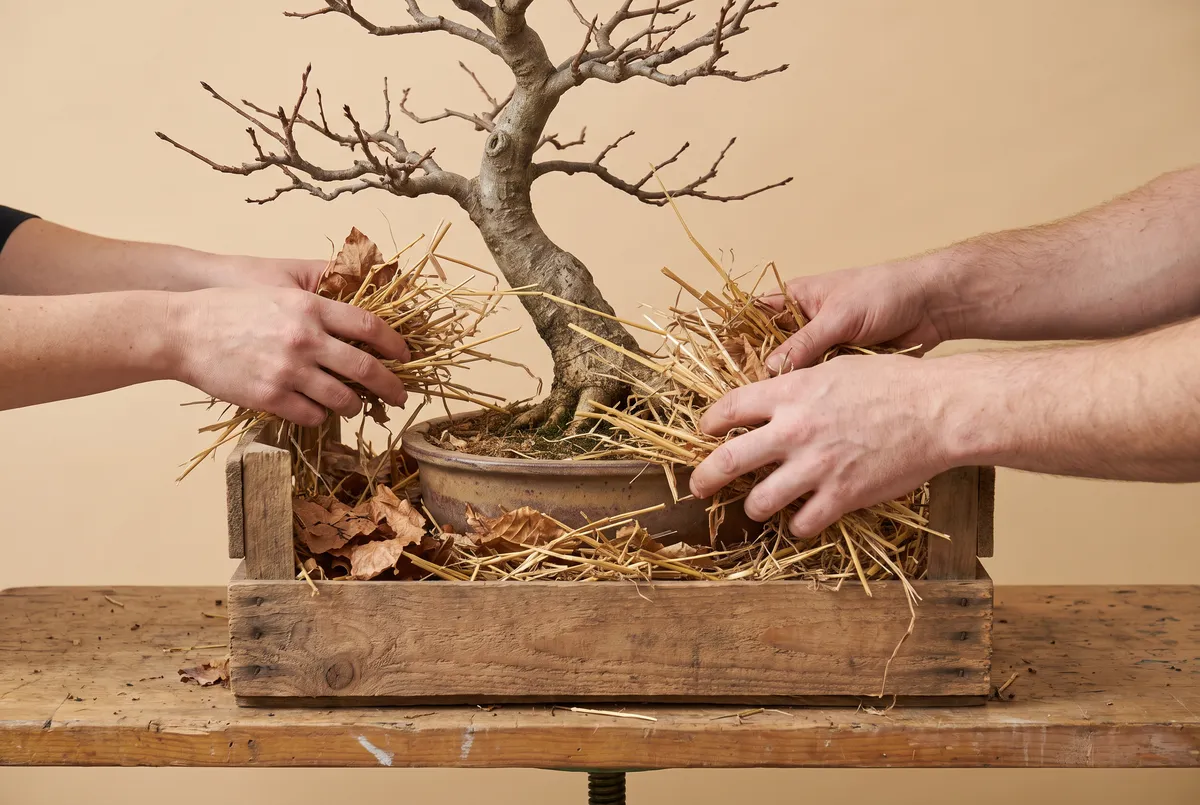
Hands packing straw around a bonsai pot inside a wooden crate, with mulch reaching the pot rim and the trunk left clear.
The balcony version of burying the pot: box it, pack mulch to the soil line, keep the trunk clear. The crate plus straw is doing what a garden bed does for everyone else.
  • Push pots against the building wall, out of the wind. The wall of a heated building leaks warmth, and a sheltered corner often runs a full zone milder than the open air a few feet away.
  • Get pots up off bare concrete. Concrete pulls heat out of the pot all night — a wood board, pot feet, or an overturned tray breaks the contact.
  • Box the pot: set it inside a cardboard or foam box and pack mulch, straw, or leaves around it. It's the balcony version of burying the pot in a garden bed.
  • On the coldest nights, drape frost cloth or an old towel over the whole setup and pull it off in the morning.

One balcony habit: check soil moisture weekly — under a roofline the trees get no rain or snow, so they dry out faster than trees mulched into open ground.

What actually kills trees in winter storage

Cold gets the blame, but most winter losses come from four quieter problems.
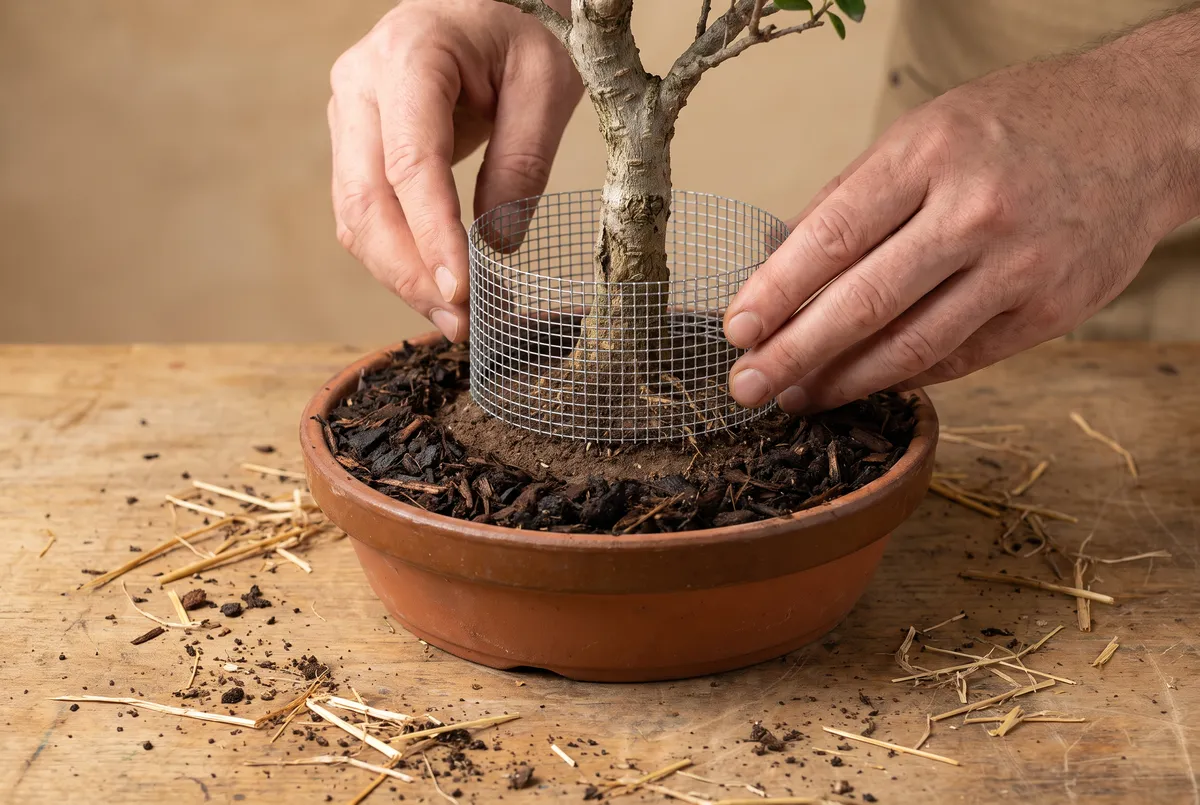
Hands fitting a small wire-mesh collar around a bonsai trunk base, with mulch cleared in a ring around the trunk.
The $10 insurance policy: a quarter-inch hardware-cloth collar standing just off the bark, mulch raked back an inch. Voles girdle trunks under cover — deny them the cover and the collar never has to work alone.
  • Rodents. Mice and voles winter under mulch and inside cold frames, girdling trunks — a tree chewed bark-deep all the way around is dead in spring no matter how well you insulated it. Wrap a collar of 1/4-inch hardware cloth around the trunk base (a $10-20 roll protects a whole collection), pull mulch back an inch from the trunk, set snap traps in the frame, and look under the mulch at every monthly check.
  • Desiccation. Winter sun and wind pull water out of evergreen foliage while frozen roots can't resupply it — the foliage bronzes and browns without ever freezing. This is the real reason for the north-side advice. A juniper that comes out of winter rusty: start with why is my bonsai turning brown before assuming the worst.
  • Cracked pots. Wet soil expands as it freezes. Free drainage plus the no-watering-before-a-hard-freeze rule prevents nearly all of it.
  • Snow. Light, dry snow is an insulating blanket — leave it on the soil. Heavy, wet snow snaps branches — brush it off the canopy before the load builds.

If a tree looks rough in March, scratch a sliver of bark before you grieve — green underneath means alive. Full checklist at is my bonsai dead.
Winter by species

  • Chinese elm: the semi-hardy special case. Zone 6 and warmer: outside with the pot mulched in. Zone 5 and colder: garage. Either way, protect the pot below about 20°F. Kept indoors instead, it skips dormancy and holds most of its leaves — pick one path and hold it for the season.
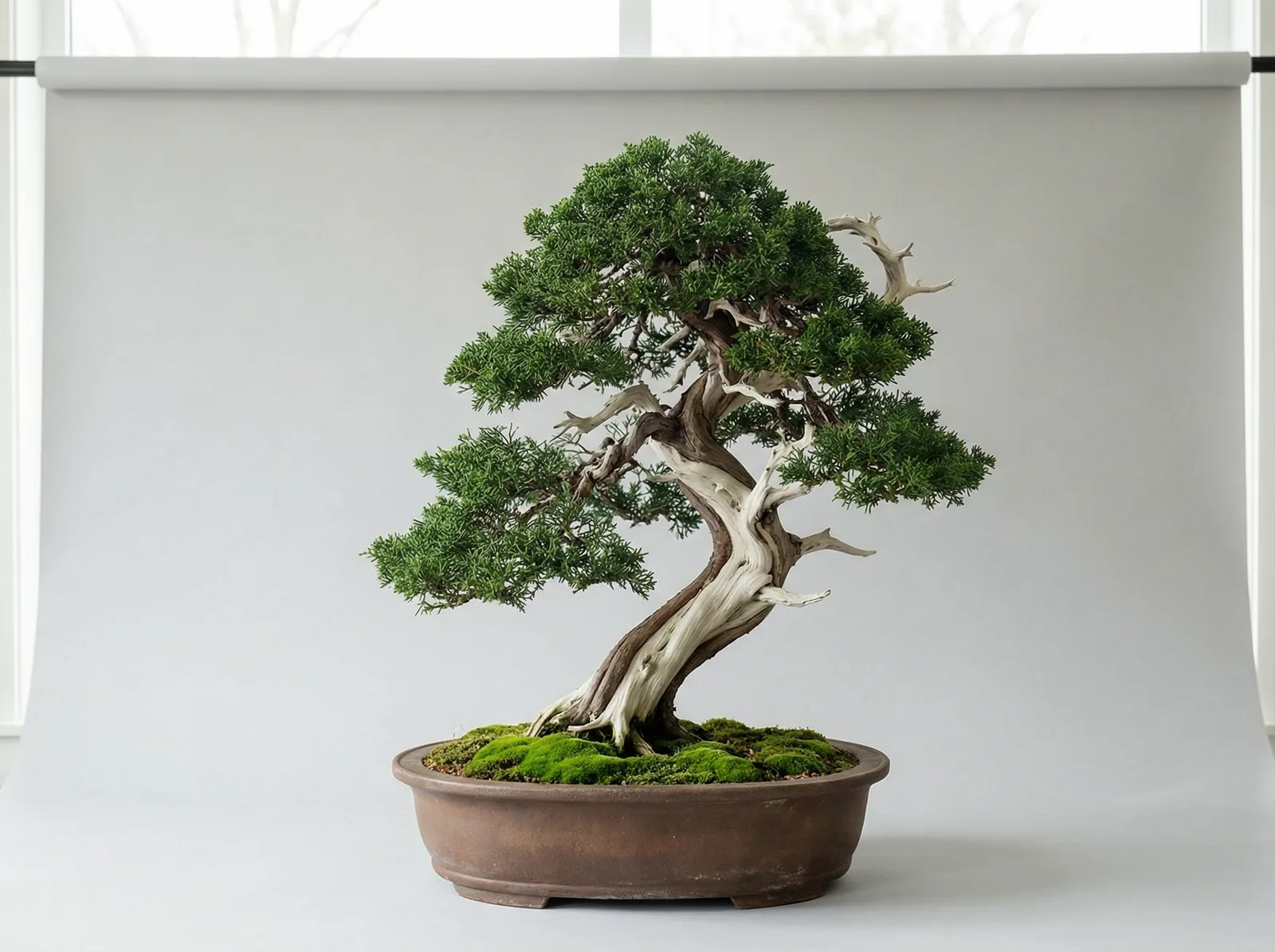
  • Juniper: the top is nearly indestructible; the roots are damaged around 15-17°F. Mulched in or cold-framed, pot protected below about 20°F, it needs nothing else.
  • Japanese maple and trident maple: the tender-rooted ones — protect below about 25°F. Both leaf out early, which makes them the classic late-frost casualty.
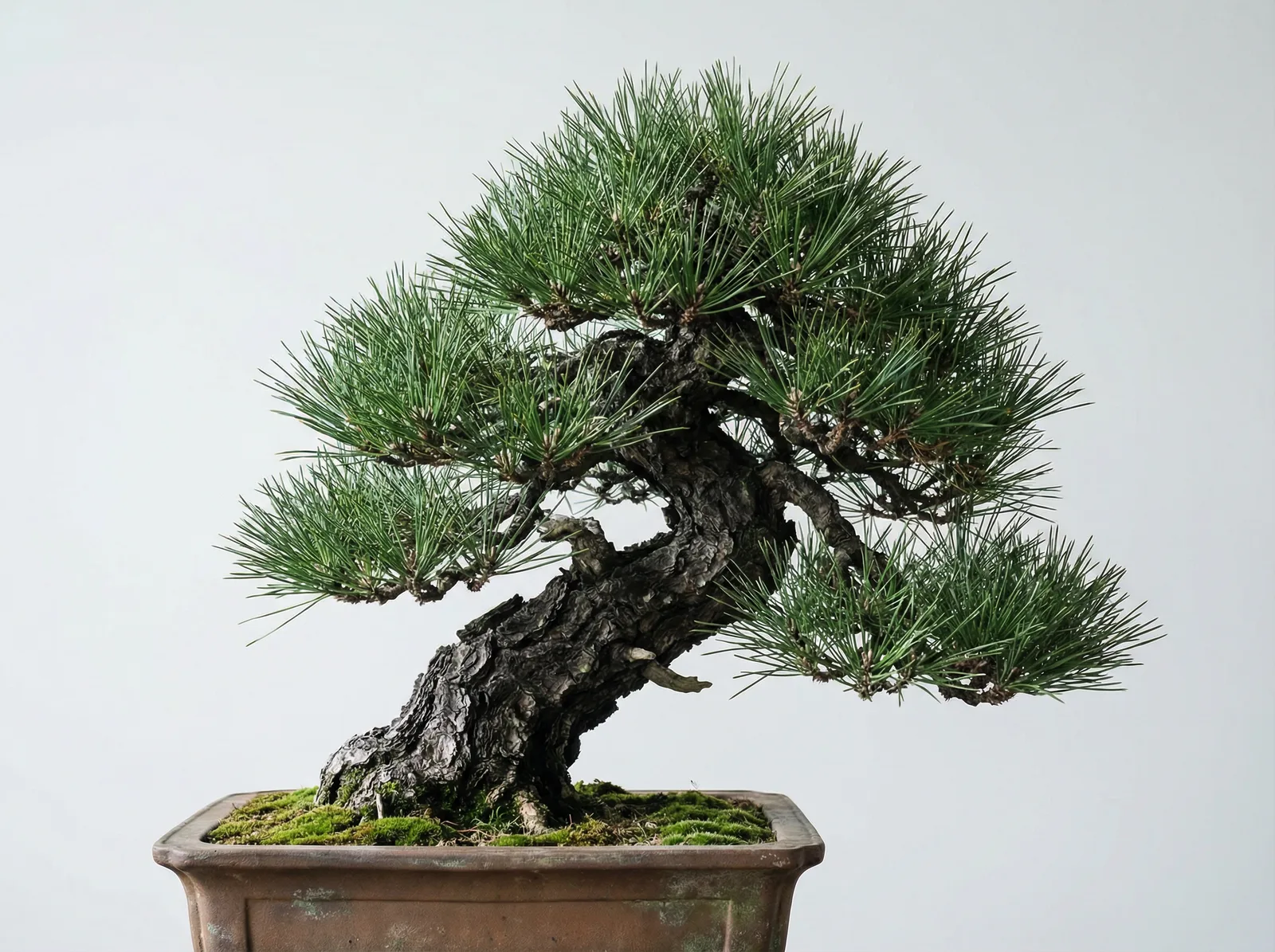
  • Black pine: hardy to -20°F in the ground; protect the pot below about 20°F. Mulch or cold frame, nothing fancy.
  • Larch: the hardiest species in our directory (zones 3-7). It's a deciduous conifer — a bare larch in November is a healthy larch. Still mulch the pot.
  • Satsuki azalea: hardy to 0°F in the ground, but protect the pot below about 20°F and out of wind — next spring's flower buds are already on the tree.
  • Olive: hardy to only 15°F — by the two-zone rule, shelter it before nights reach the mid-20s. A frost-free garage or bright porch is plenty; it wants cool rest, not deep cold.
  • Ficus, jade, Fukien tea, schefflera: tropicals — indoors before nights hit 50°F, per the setup above.

Quick winter sheet

  • The roots are the vulnerable part; the top is built for cold. A potted tree acts about two zones less hardy than in the ground.
  • Target root-zone range: 25-45°F for temperate species.
  • Protect after two or three hard frosts, not the first light one; release gradually at bud swell, frost cloth on standby.
  • Zone 6+: mulch pots into the ground on the north side. Zones 3-5: unheated garage or cold frame.
  • Balcony: against the wall, off bare concrete, pot boxed in mulch.
  • Water only unfrozen soil, only when it's dry a finger-depth down.
  • Hardware-cloth collar against voles; brush heavy snow off branches; ignore a February warm week.
  • Tropicals come inside once nights drop below 50°F — and drink less all winter.

Winter Care for Bonsai Trees: FAQ