Bonsailist
SpeciesCategoriesGuidesQuestionsToolsStylesAbout
Bonsailist

The field guide for your first bonsai — care with real numbers, honest species picks, and tools that do the math for you.

Browse

  • All Species
  • Categories
  • Bonsai Styles
  • Compare Species

Learn

  • Care Guides
  • Bonsai Tools
  • Common Questions
  • Best For
  • Climate Zones

About

  • About Us
  • Sitemap
© 2026 BonsaiList. All rights reserved.
Privacy PolicyTerms of ServiceAccessibility
  1. Home
  2. /
  3. Guides
  4. /
  5. Indoor Bonsai Growing Guide
Field guide

Indoor Bonsai Growing Guide

Growing bonsai indoors works perfectly well — if you pick tropical species, get the light right, and manage humidity. Here's the honest playbook.

On the benchfull-spectrum grow lighthumidity traysmall fantimer for grow lightspray bottlehygrometer

On this page

  1. Pick from the indoor list
  2. Light is the bottleneck
  3. Buying a grow light that works
  4. The summer vacation outdoors
  5. Watering and winter humidity
  6. Temperature, airflow, and the weekly quarter-turn
  7. Reading an unhappy indoor tree
  8. The indoor year
  9. Quick indoor sheet

The biggest myth in this hobby is that all bonsai must live outdoors. It's repeated so often that beginners without a yard feel shut out before they start. The reality: tropical species grow perfectly well inside a house year-round. They don't need winter dormancy, they handle the temperature stability of an apartment, and with decent light they develop just as nicely as any outdoor tree. Different species, different setting, same art form.

Pick from the indoor list

Indoor growing is won or lost at the species decision, before you've watered anything. A tropical tree never evolved a winter shutdown, so a heated living room suits it fine. A temperate tree reads short days and cold as its cue to rest — and a bookshelf never sends the cue.

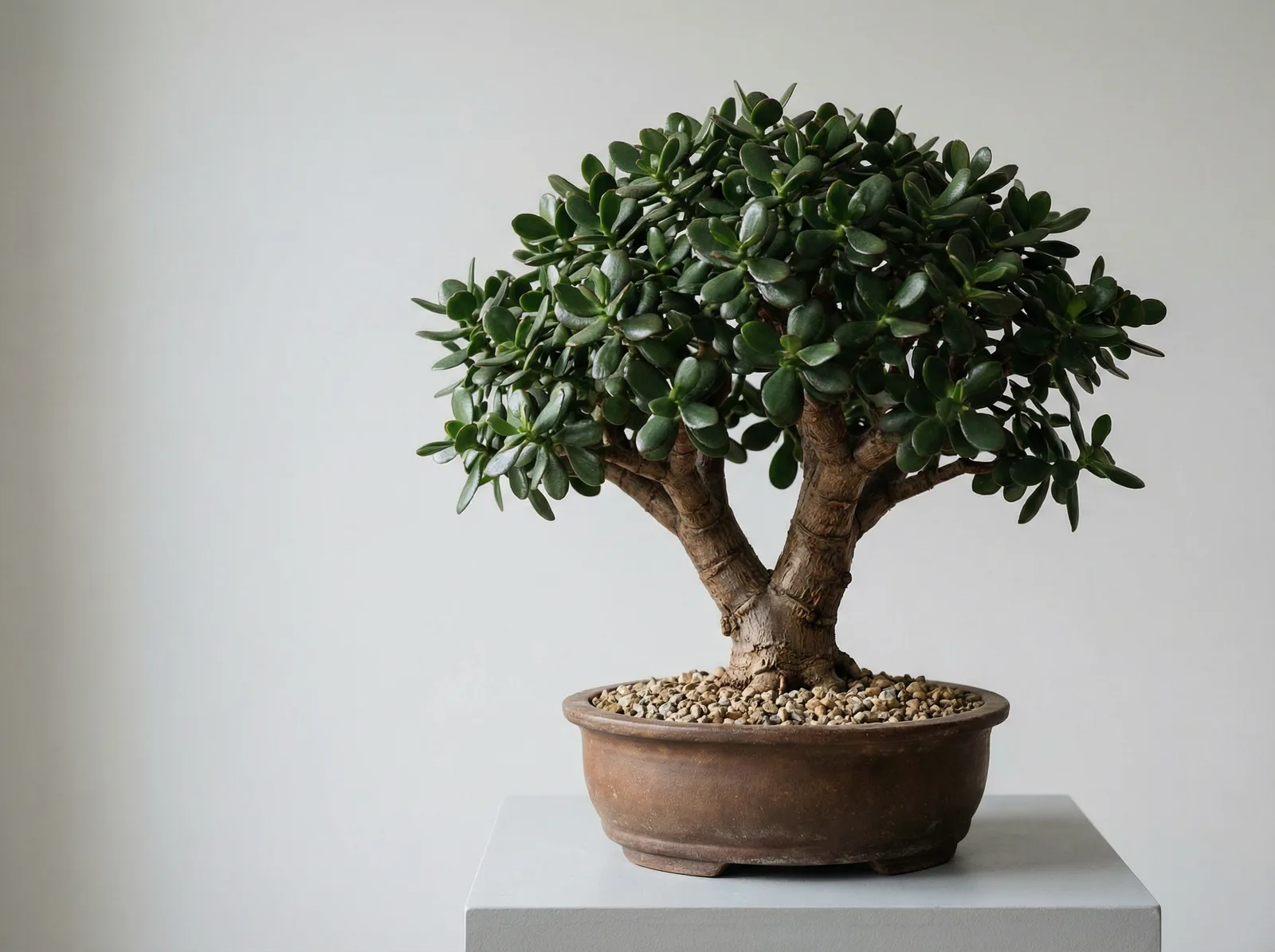
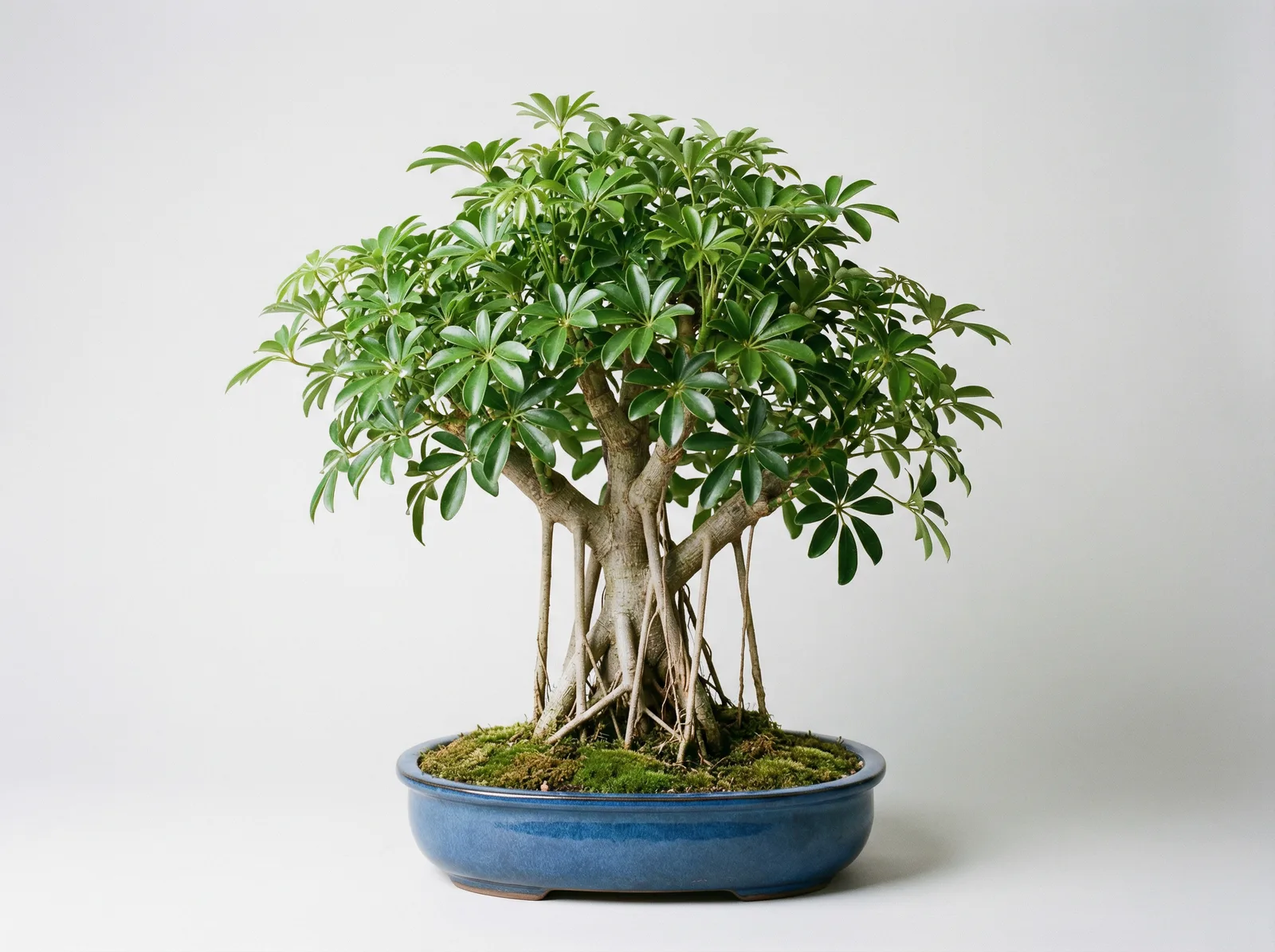
The proven indoor species: ficus (retusa and microcarpa especially), jade, dwarf jade, schefflera, and Fukien tea. The full roster lives at indoor bonsai. They are not interchangeable:

  • Ficus: the indoor benchmark. Bright indirect light, 60–85°F, and it forgives more watering mistakes than anything else here. One quirk: it sheds leaves after any relocation — more on that below.
  • Jade and dwarf jade: give them your single brightest spot and water far less than the rest. These are succulents; winter-dry apartment air suits them, so skip the humidifier fuss for these two.
  • Schefflera: handles a merely decent window better than anything else on the list. If your best light is an east window, start here. Its small-leaved cousin the Hawaiian umbrella is just as forgiving.
  • Fukien tea: the fusspot — steady 60–75°F, moderate-to-high humidity, zero cold drafts. A fine second tree and a frustrating first one.
  • Money tree: the braided-trunk money tree takes bright indirect light and tolerates a skipped watering better than a doubled one. A good gift-tree on-ramp.
  • Chinese elm: the asterisk. A Chinese elm survives in a bright window, but it's a semi-hardy tree that grows best with an outdoor season — treat indoors as its winter quarters, not its address.

The species this does NOT include: junipers and every other temperate tree.

Never

Never keep a juniper — or any temperate species — indoors: these trees need a cold winter dormancy to reset their energy budget, and in a heated room they burn through stored reserves and decline over 6–12 months, often staying green until near the end.

That's a species mismatch, not a skill problem.

Light is the bottleneck

The window testrate your spot
Which way does the window face?
Where would the tree sit?
Grow light?

Every leaf is a sugar factory and light is the raw material. Even a bright south-facing window delivers a fraction of what a tree gets on an outdoor bench — but a fraction can be enough. A ficus in a sunny south window pushes growth all year. East and west windows work with slower growth. North windows don't support much of anything without help. The full sun-requirements picture is at do bonsai need direct sunlight.

The number beginners miss is distance. Light collapses as you step back from the glass: a tree three feet from a south window gets somewhere between a tenth and a quarter of what it would get at the sill. "In the window" means touching the glass — a sill, a plant stand pushed against it — not the console table six feet into the room.

And skip the bathroom hack. A bathroom is a dark room with two short humidity spikes a day; light matters far more than shower steam. A tropical tree in a bright dry room beats one in a humid cave every time.

Buying a grow light that works

A full-spectrum LED makes window orientation irrelevant: hang it 6–12 inches above the canopy and run it on a timer 12–14 hours a day. The target at leaf level is 200+ PPFD — the count of usable light photons actually landing on the foliage — or roughly 2,000 lumens as a stand-in. Electricity runs a couple of dollars a month. What that spec means at the store:
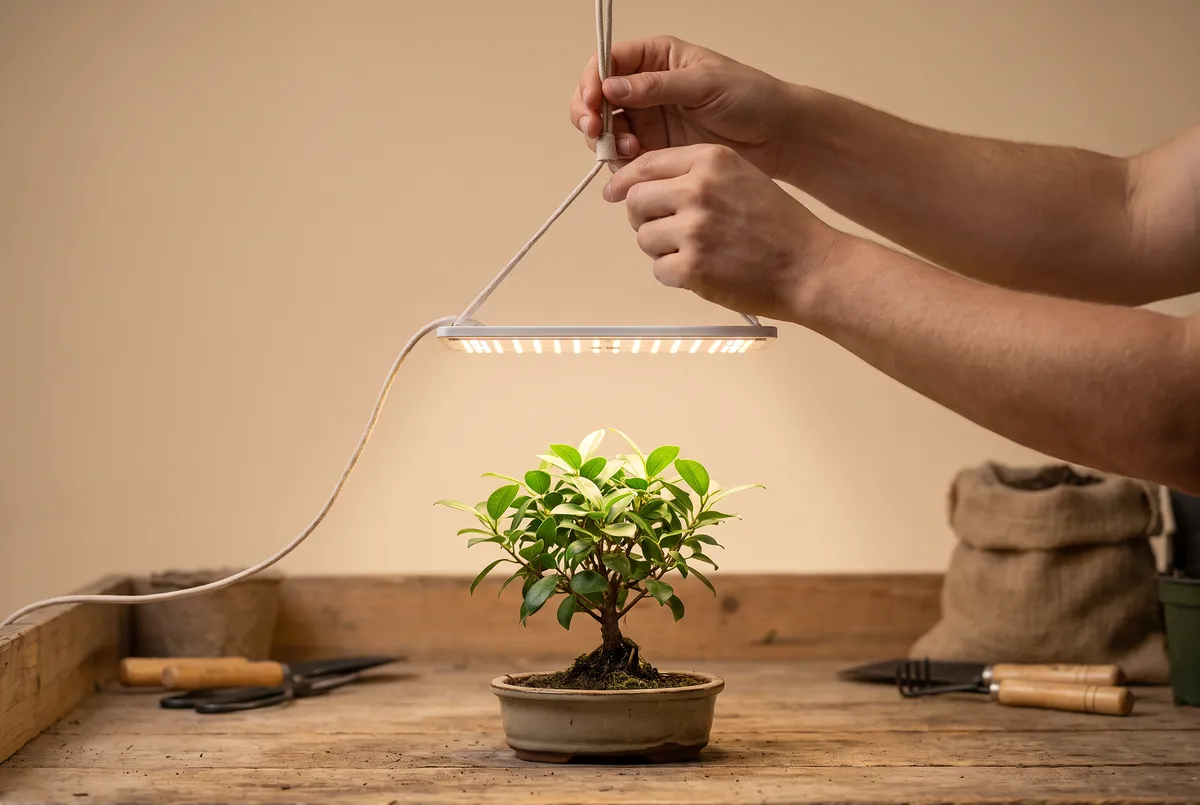
Hands adjusting a flat LED grow panel hanging just above the canopy of a ficus bonsai on a wooden nursery workbench
The panel hangs 6–12 inches above the canopy — closer than looks reasonable — on a timer for 12–14 hours a day. Distance is the spec people get wrong, not wattage.
  • Quantum-board LED panel (a flat board of many small diodes), 20–40 actual watts, $30–60: the right buy for most setups. Covers roughly a 2×2-foot area and delivers 200+ PPFD at 6–12 inches — enough to grow a ficus, not just keep it breathing.
  • T5 or LED strip, $20–40: fine over a shelf of small trees. Weaker per square foot — hang it 4–8 inches above the foliage and expect maintenance, not vigor.
  • $15 clip-on bulb: mostly decor. Most deliver under 50 PPFD at leaf distance — enough for a pothos, not a bonsai. Skip it.

Read the actual wattage drawn from the wall, not the "600W equivalent" number on the box. A panel pulling 20–40 real watts is in the range that works.

The summer vacation outdoors

The single biggest lever an indoor grower has costs nothing: put the tree outside for the summer. Even open shade outdoors is several times brighter than a windowsill, and a tropical tree answers with a flush of growth no indoor setup matches.
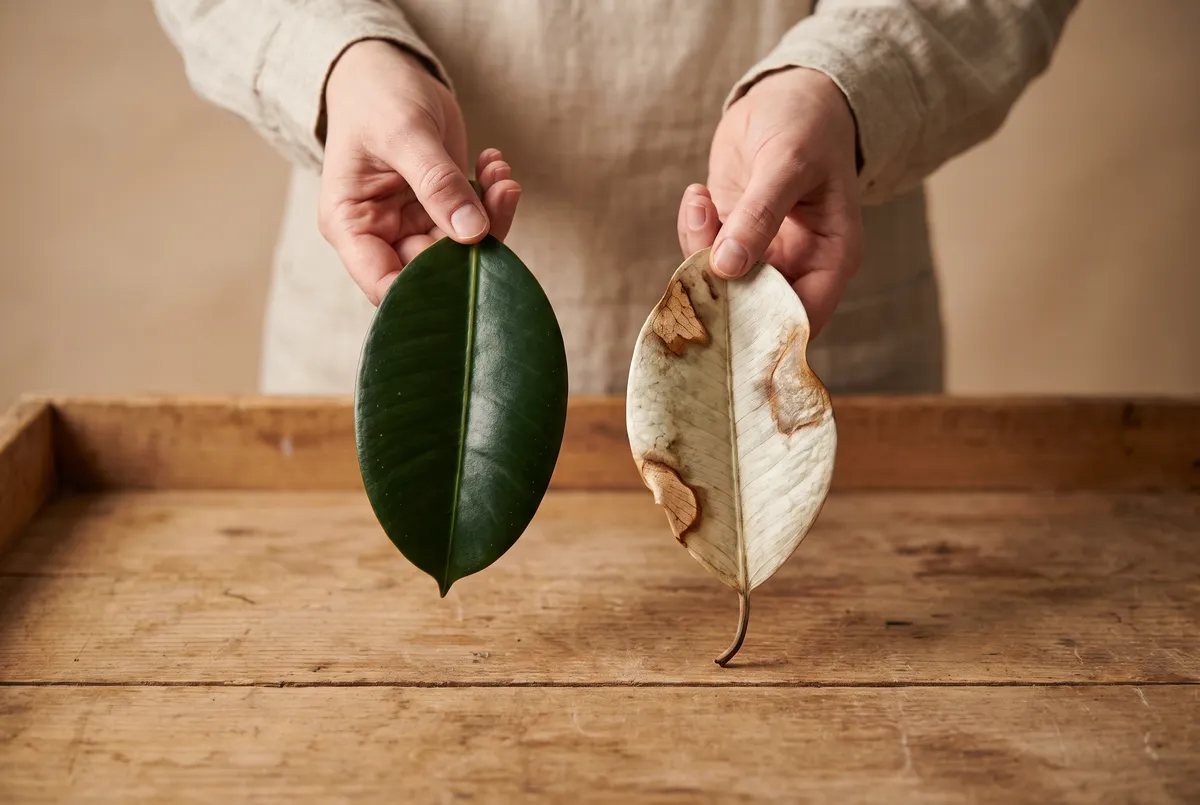
Hands holding two ficus leaves over a wooden workbench: one healthy deep green, one bleached white-brown with scorched papery patches from sudden sun exposure
Left: a sun-hardened leaf. Right: what one afternoon of unfiltered summer sun does to a leaf grown indoors. This is why the move outside starts with 1–2 weeks of full shade.

Bench rule

Once night temperatures hold reliably above 50°F (55°F for the fussier species like Fukien tea), move your tropical bonsai outside — it will grow more in that one season than in the previous eight months indoors.

Acclimate it first. Leaves grown indoors are shade leaves — thinner-surfaced and built for low light.

Never

Never move an indoor tree straight into direct outdoor sun — indoor-grown leaves lack the thick protective surface that sun leaves build, and unfiltered summer sun bleaches them white-brown in a single afternoon.

The protocol: one to two weeks in full shade, then a week of morning sun only, then its summer position. Reverse the trip in fall — when nights start sliding toward 50°F, bring trees in, and inspect them on the way: hose down the foliage, check leaf undersides, and keep the returnee a room away from other houseplants for a week or two. Half the winter pest problems on indoor benches walked in the door in September.

Watering and winter humidity

Without wind and direct sun, soil dries much slower than outdoors — the most common indoor bonsai death is a well-meaning owner watering on a schedule into soil that never dries.

Bench rule

Check with a finger half an inch down every day, but water only when it's dry at that depth — indoor soil can take 4–6 days to dry in winter, and a calendar schedule will drown the tree.

The full technique is in the watering guide, and how often to water a bonsai covers frequency by season and setting.

Humidity is the other winter variable, October through March. Heating systems drop most homes to 30–40% relative humidity; tropical bonsai want 50–70%. A pebble tray under the pot helps a little. Grouping trees creates a shared microclimate. The fix that actually moves the number is a small cool-mist humidifier pointed at the growing area — a $25 solution to the most common indoor complaint.

Temperature, airflow, and the weekly quarter-turn

Comfortable in a t-shirt? Your tropical bonsai is comfortable too. Keep trees between 60–80°F, away from drafty windows, heating vents, and radiators. Tropicals tolerate steady-cool or steady-warm far better than a spot that swings 20 degrees three times a day.
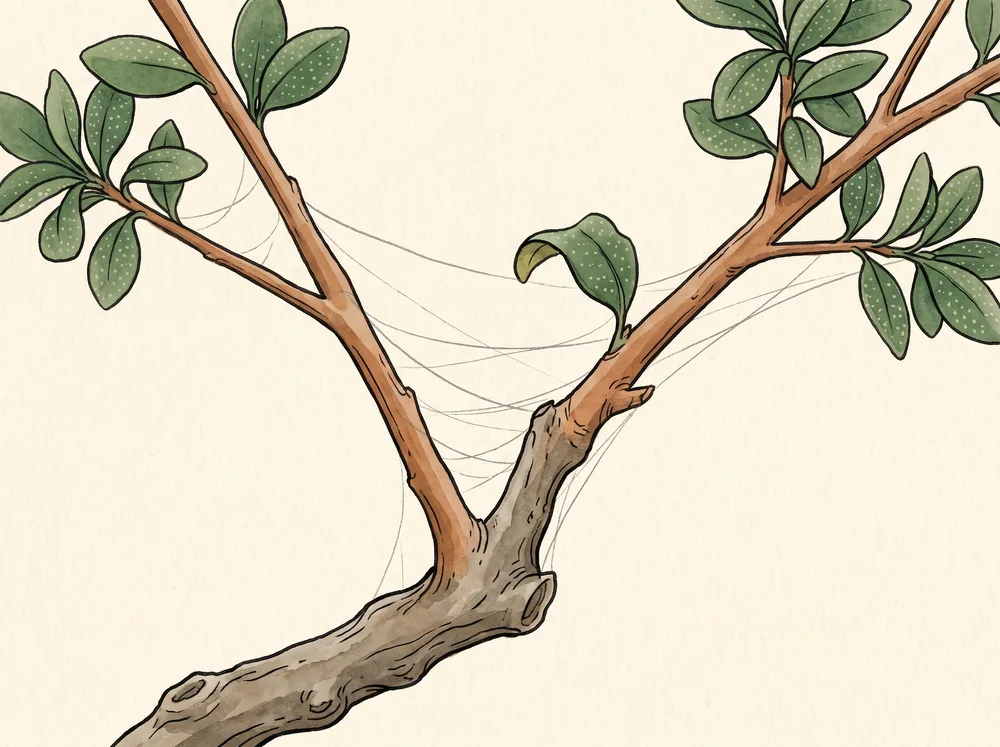
Illustration of a bonsai branch fork with fine spider-mite webbing spanning the junction and pale stippling on the surrounding leaves
Fine webbing in the branch junctions plus dusty, stippled leaves is spider mites — bred in still, dry winter air. Shower the whole canopy in the sink and start the fan.

Stagnant indoor air is spider mite paradise. A small desk fan on low, running a few hours daily near (not at) the trees, deters pests, helps soil dry at a healthier rate, and even strengthens trunks slightly.

Quarter-turn the pot every week if the tree sits in a window, or every branch will reach for the glass. Feed year-round but lightly — half-strength liquid every two to three weeks while the tree is pushing growth, stretched toward monthly through the winter stall, or organic cakes replaced monthly (see the fertilizing guide). Indoor trees grow slower than outdoor ones, and unused fertilizer just builds up salts.

Reading an unhappy indoor tree

Indoor trees fail in a small number of recognizable patterns, and nearly all of them trace back to light or water. Match the pattern first, act second:
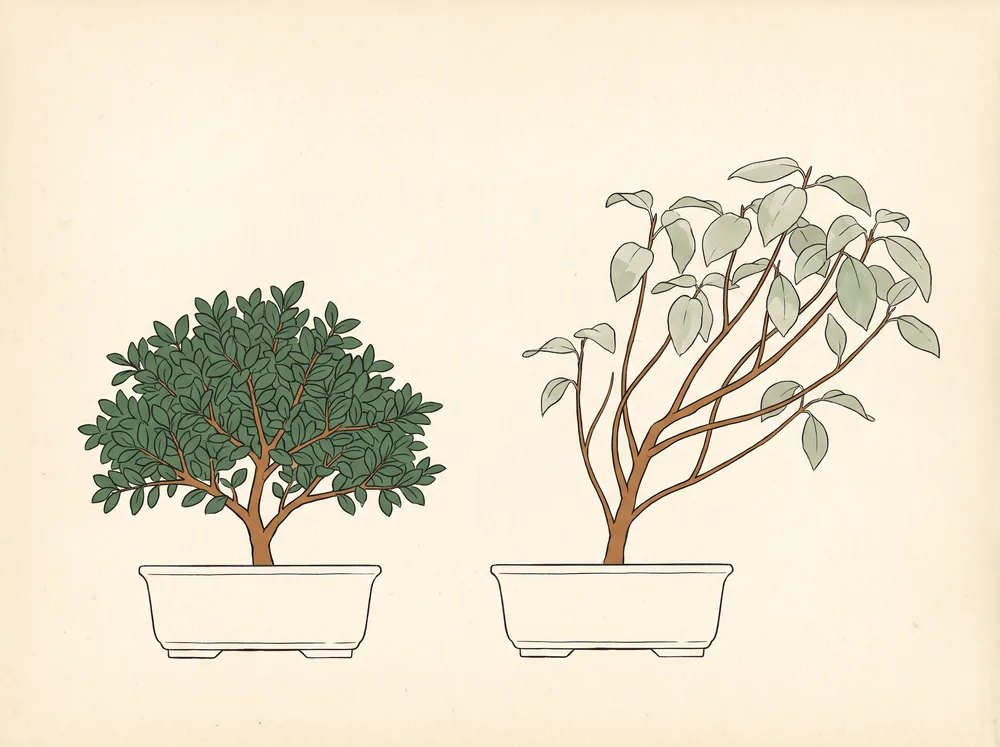
Field-guide illustration comparing a compact, densely-leaved ficus bonsai with an etiolated one showing long bare stems, sparse pale oversized leaves, and a crown leaning to one side
Same species, same pot, different light. Long bare stems and oversized pale leaves are etiolation — the tree stretching to hunt photons. More light is the only fix; fertilizer just makes it stretch faster.
  • Long bare stretches of stem, oversized pale leaves, branches leaning into the glass: not enough light. The tree is stretching to hunt photons — botanists call it etiolation, and it's the defining indoor failure signature. More light is the only fix: closer to the window, or a real panel. Fertilizer makes an etiolated tree stretch faster, not better.
  • Ficus dropped a third of its leaves right after a move: normal. A relocated ficus routinely sheds for 2–4 weeks, then reflushes on the new light. Stop moving it, keep watering by the finger test, and wait. Still shedding at week six? Work through why is my bonsai dropping leaves.
  • Yellow, soft leaves and soil that never dries: overwatering. Let the pot dry to a half-inch depth before the next water and recheck the drainage holes; why is my bonsai turning yellow walks the full diagnosis.
  • Dusty, stippled leaves and fine webbing in branch junctions, usually midwinter: spider mites, bred in still dry air. Shower the whole canopy in the sink, start the fan, and follow the pest control guide for the spray routine.
  • Brown, crispy leaf tips: dry air, dry soil, or both. Raise the humidity and tighten the finger-test habit before assuming anything worse.

Bench rule

If new leaves keep coming in bigger and paler than the old ones, treat it as a light problem no matter what else seems plausible — no watering or feeding change fixes a light shortage.

The indoor year

Indoor trees still have a season — just a gentler one. Late spring, once nights hold above 50°F, they go out. Early summer is repotting time for tropicals — June is the classic window — using the 40/30/30 akadama-pumice-lava tropical mix (size the batch with the soil calculator, technique in the repotting guide). Summer outdoors means an outdoor watering rhythm: check daily, water most days. Early fall, before nights dip below 50°F, they come back in with the pest inspection. Then from roughly November to February comes the stall: short days, weak light, a tree that barely moves even under a panel. That's normal — water slower, feed monthly, run the humidifier, and let it idle. Growth returns with the daylight in March.
Quick indoor sheet

  • Species: ficus, jade, dwarf jade, schefflera, Fukien tea. Never juniper.
  • Light: touching a south window, or a 20–40W panel ($30–60) hung 6–12 inches up, 12–14 hours on a timer.
  • Water by finger test, not schedule — indoor soil can take 4–6 days to dry in winter.
  • Summer outside once nights hold above 50°F; acclimate in shade for 1–2 weeks first.
  • Winter: add humidity (tray, grouping, $25 humidifier), expect the stall, stretch feeding toward monthly.
  • Run a small fan; rotate the pot weekly; repot tropicals in early summer.

Indoor Bonsai Growing Guide: FAQ