Portulacaria afraboth
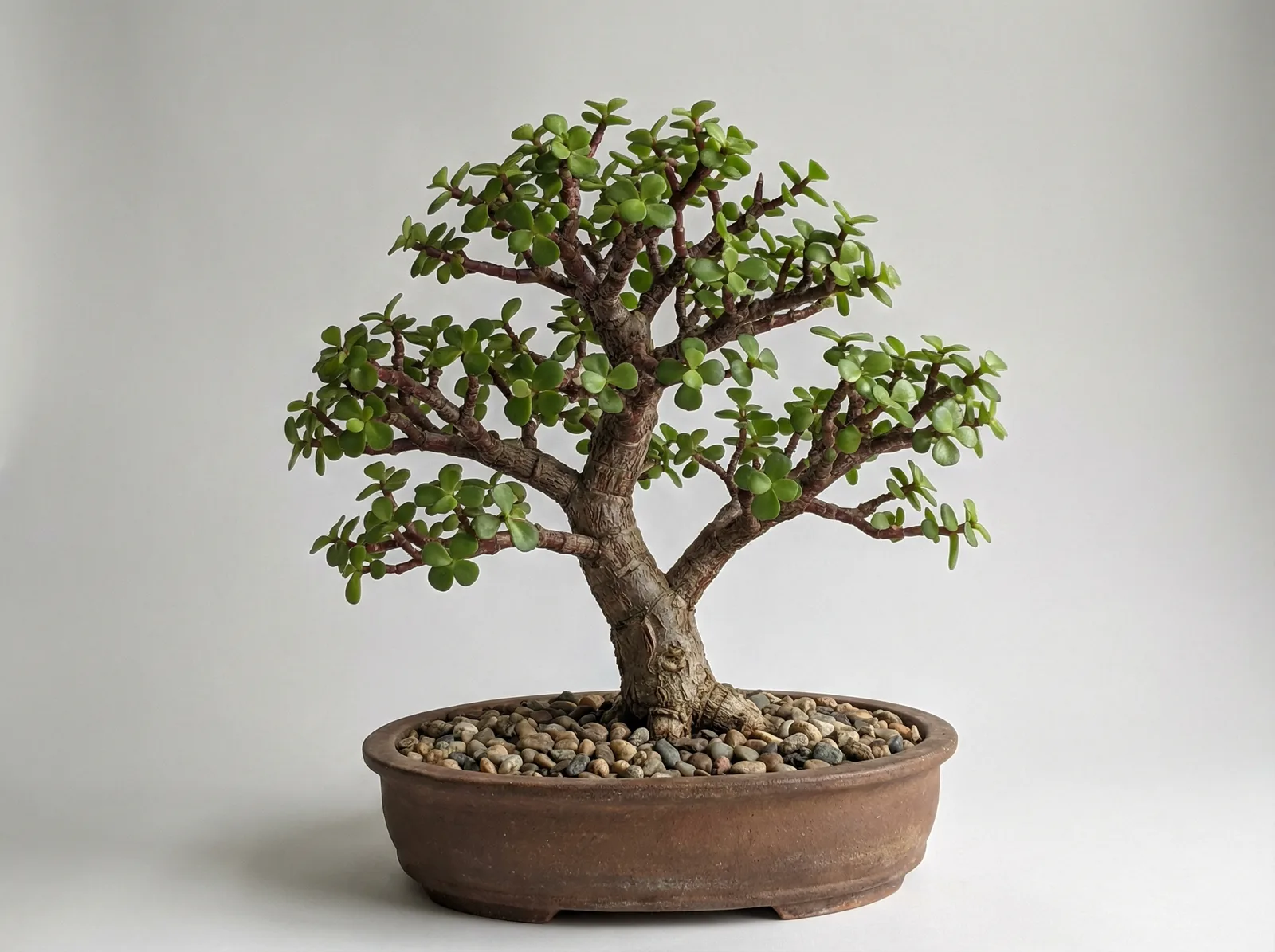
Dwarf Jade Bonsai
- care
- beginner
- light
- full sun
- zone
- 9–11
Crassula ovata · Crassulaceae
Why grow it
Jade bonsai break the rules that apply to every other tree on this list. Crassula ovata is a succulent—it stores water in its fat leaves and swollen trunk, shrugs off weeks of neglect, and couldn't care less about humidity. If you kill houseplants by forgetting they exist, jade might actually be your best option.
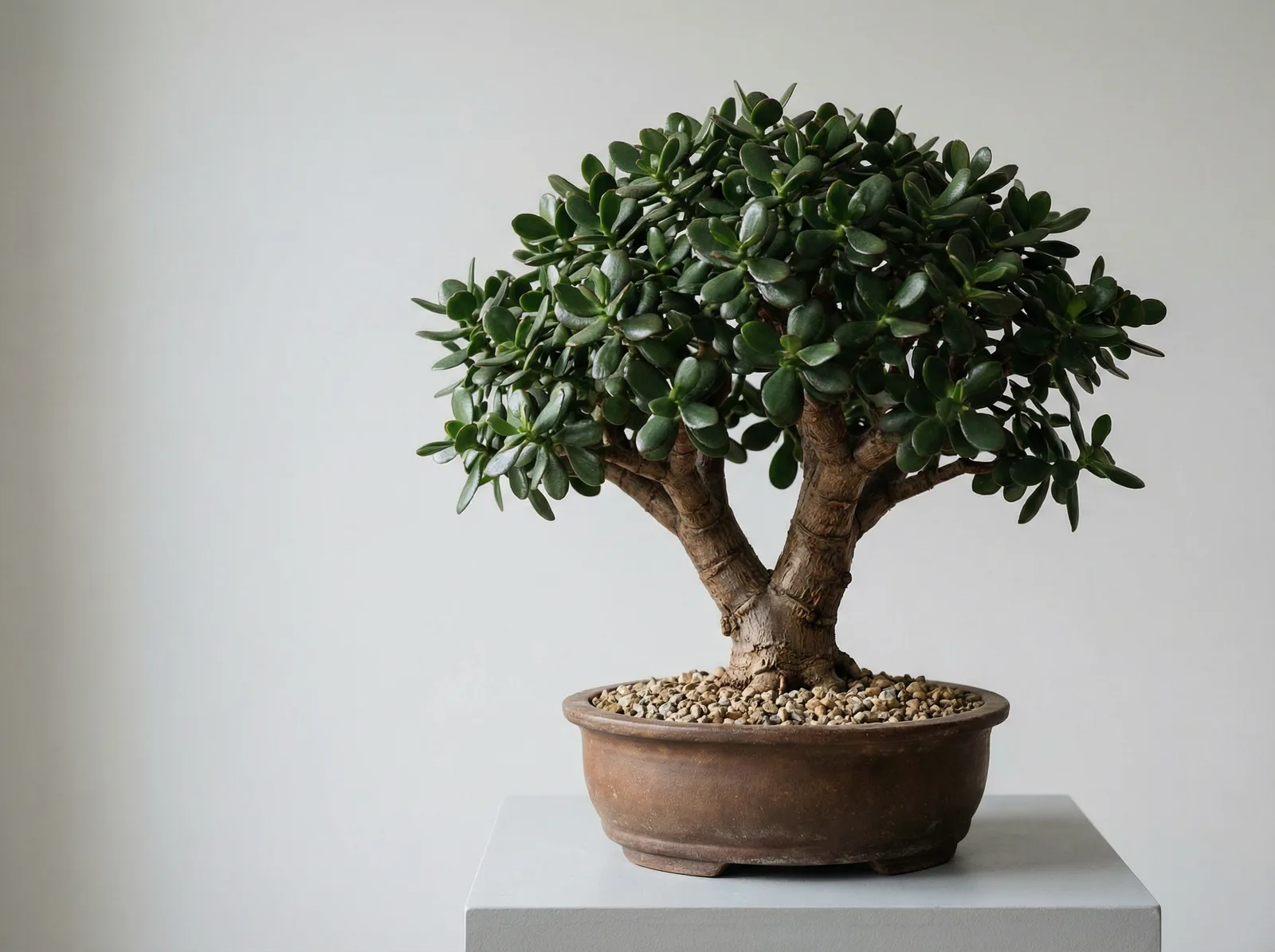
The trunk thickens surprisingly fast. A pencil-thick cutting can develop a 2-inch trunk in four or five years with good growing conditions and strategic pruning. The wood is soft and pale, the leaves are glossy and rounded, and the overall look is distinctly different from any traditional bonsai species. Some purists don't consider it "real" bonsai. Who cares. It looks great in a pot.
Mature jade can even flower—small white or pink star-shaped blooms in late winter, triggered by a cool, dry rest period. Not the main reason to grow it, but a nice surprise when it happens.
The routine
Here's the thing about jade: most people water it way too much. It's a succulent from the dry scrublands of South Africa. It doesn't want moist soil. It wants to dry out completely, sit dry for a few days, then get a thorough drench. Stick your finger two inches into the soil. Any moisture at all? Don't water. Wait. When the soil is bone dry all the way through, soak it until water pours out the drainage holes. In summer, that cycle runs about every 7-10 days. In winter, every two to three weeks.
Light makes the difference between a leggy houseplant and something that actually looks like a tree. Jade want direct sun. Four to six hours minimum, and more is better. South-facing window is ideal. No bright window? Use a grow light, 12 hours daily. Without enough light, the internodes stretch and the leaves space out, and you end up with a gangly stick instead of a compact tree.
Jade looking rough right now?Skip to common problems below, or start with the symptom guide.Summer outdoors is a game changer. Move your jade outside once night temperatures stay above 50°F consistently. Acclimate over a week in shade first—sudden full sun will sunburn the leaves white. In strong outdoor light, the leaf edges turn a beautiful reddish-purple. Totally normal. Totally desirable.
Soil must drain fast. Mix 70% inorganic—pumice, perlite, or coarse sand—with 30% cactus soil or pine bark fines. Water should run straight through. If it pools on the surface even for a moment, your mix is too dense and root rot is coming.
Feed lightly. Half-strength balanced fertilizer once a month from April through August. That's it. Jade are adapted to nutrient-poor soils. Heavy feeding produces soft, floppy growth that doesn't look like bonsai.
Shaping
Every cut on jade needs to happen at a node—the point where leaves attach to the stem. Cut between nodes and the stub dies back to the next node anyway, just messily. So save yourself the trouble and cut clean at the joint.
After you cut, let the wound dry for 24 hours before watering. Jade tissue is succulent and wet inside. A fresh cut sitting in moist soil is an invitation for rot. No wound sealant needed—the cut calluses over on its own.
Leaf removal works differently than on deciduous trees. Pluck off the largest leaves to redirect energy into developing branches and producing smaller replacement foliage. Over months, controlled leaf removal combined with reduced watering produces noticeably smaller leaves.
Hard pruning? Go for it. Cut jade back to 2-3 inches above the soil and it pushes new growth from below every cut. Major reshaping is best done in April or May when the growth response is strongest. The only limit is that jade don't back-bud readily from bare trunk—make sure you're cutting back to a section that has at least one node or leaf pair.
Forget wiring old branches on jade. Anything thicker than a pencil is too brittle and will snap. Period. Wire only young, green shoots with the thinnest aluminum that holds the bend (/tools/wire-gauge if you want a number), and even then watch closely—jade bark bruises if you look at it wrong. Leave wire on for 2-3 months maximum, then remove and assess.
The real styling tool for jade is the pruning shear. Clip-and-grow is how you build structure. Let a shoot extend, cut it back, direct the new growth with selective pruning. It's slow compared to wiring a juniper, but the results look more natural because you're working with how the tree actually grows.
Upright styles with thick, tree-like trunks are the goal. The natural growth habit is dense and bushy—your job is to edit it into something that reads as "tree" rather than "houseplant." Remove lower branches to expose trunk. Thin the canopy so you can see branch structure. Create defined foliage pads at the tips.
Exposed roots add tremendous character. At each repotting, plant the tree slightly higher. Over several cycles, the root base becomes visible and thickens, eventually looking like buttress roots on a tropical giant. A 10-inch jade with exposed roots and defined branching has a presence that belies its size.
When things go wrong
Overwatering kills more jade bonsai than everything else combined. The sequence looks like this: yellow leaves appear, then they go soft and translucent, then they fall off. If you catch it early, just stop watering and let the soil dry completely. If the stem at the base is mushy and dark, you've got rot. Cut above the rot to healthy tissue, let the cutting dry for three days, then root it in dry sand. You're starting over, but at least the genetics survive. And skip the bark scratch test you'd use on a woody tree -- on jade, the live-or-dead check is turgor: healthy tissue is plump and firm, leaves snap crisply, stems feel solid. Wrinkled-but-firm means thirsty (easy fix); soft, translucent, or dark from the soil line upward means rot (act now).
Mealybugs are jade's nemesis pest. White, cottony clusters hiding in the crevices where leaves meet stems. They're easy to miss until there are dozens. Check your tree weekly—flip it upside down and look into the leaf axils. Dab each one with a cotton swab dipped in rubbing alcohol. For bad infestations, spray with 70% isopropyl alcohol mixed with a drop of dish soap.
Shriveled, wrinkled leaves mean the tree is thirsty. This is the opposite problem from overwatering, and it's much easier to fix. Give it a deep soak and the leaves plump back up within a day or two.
Leggy growth—long stems with wide spaces between leaf pairs—is always a light issue. More sun, shorter internodes. Prune back the stretched sections and improve the lighting. New growth will be compact.
Every garden center in America sells jade plants. A 4-inch pot runs $5-8, a 6-inch pot $10-15. Buy the one with the fattest trunk—that's years of growth you don't have to wait for. Don't bother with "bonsai-shaped" jade in decorative pots at twice the price. You're paying for the pot and some basic pruning you could do yourself in five minutes.
For serious jade bonsai with thick trunks and developed branching, Eastern Leaf and Wigert's carry pre-bonsai specimens for $40-150. These save you 5-10 years of trunk development. Look for specimens with a trunk at least 1.5 inches in diameter and some visible taper—that's the foundation you need for a convincing bonsai.
Some links may become affiliate links; our picks don't change.
Also on the bench