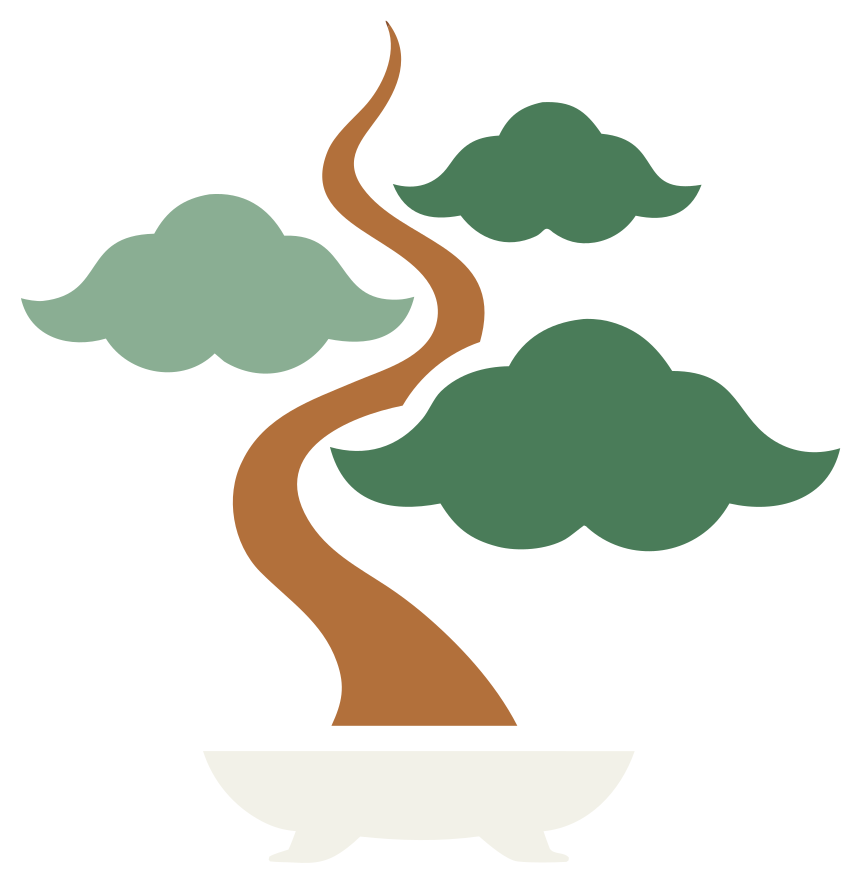
Each style mimics how a real tree grows somewhere — an open field, a cliff face, a windy ridge. Learn the shape's logic first; the rules follow from it.
Print the one-page styles chart →Chokkan
Formal upright is the foundation of bonsai design. A straight trunk, symmetrical branches, and a tapered silhouette narrowing from base to apex — it mimics a tree growing alone in an open field with no competition for light and no wind to speak of.
Moyogi
Informal upright is the most common bonsai style, and honestly, it's the most natural-looking. The trunk curves gently as it rises — S-curves, C-curves, subtle bends — mimicking a tree that grew through shifting light, occasional shade, or mild wind. Unlike formal upright's rigid precision, moyogi feels relaxed and organic.
Shakan
The slanting style captures a tree that's been pushed sideways — by decades of prevailing wind, by reaching toward light at a forest edge, or by growing on a hillside. The trunk angles between 60 and 80 degrees from vertical. Enough to look intentional. Not so far it becomes a cascade.
Kengai
Cascade bonsai are pure drama. The trunk — or a major branch — plunges below the bottom of the pot, mimicking a tree growing on a cliff face where gravity, snow load, and rockfall have pulled it downward over centuries. Of all the classic styles, cascade makes the boldest visual statement.
Han-Kengai
Semi-cascade sits in the sweet spot between slanting and full cascade. The trunk or a major branch extends outward — horizontally or angling slightly below the pot rim — but doesn't drop below the pot's bottom. Think of a tree reaching out over a riverbank, or leaning from a lake shore toward reflected light on the water.
Fukinagashi
Windswept bonsai tell a survival story with every branch and every strip of bare wood. All foliage pushes in one direction, as if decades of relentless coastal wind bent the tree permanently to one side. Dead branches (jin) and stripped bark (shari) on the windward face complete the picture: a tree battered by the elements but absolutely refusing to die.
Bunjin
Literati is the rebel style. Where formal upright prizes symmetry and proportion, literati celebrates emptiness and line. A thin, twisting trunk rises high — sometimes dramatically high — with almost no branching until a small, spare crown perches at the top. It's bonsai reduced to a single brushstroke: all movement, all story, almost no foliage.
Yose-ue
Forest planting uses multiple trees in a single pot to recreate the feeling of walking into a grove. Done well, the viewer stops seeing individual trunks and starts seeing a landscape — depth, perspective, the quiet atmosphere of a woodland. It's one of the few bonsai styles where the composition outweighs any single tree.
Sekijoju
Root over rock is part bonsai, part living sculpture. The tree's roots grip and flow over a rock before plunging into the soil below, creating a composition that merges organic curves with hard stone. It represents trees growing on rocky mountain slopes or eroded riverbanks where soil has washed away, leaving roots exposed and clinging to whatever surface they can find.
Hokidachi
Broom style replicates the silhouette of a solitary deciduous tree standing in an open field — a straight trunk dividing into a fan of branches that form a rounded, dome-shaped canopy. Picture a full-grown elm or zelkova on a village green: broad, symmetrical, inviting shade in every direction.