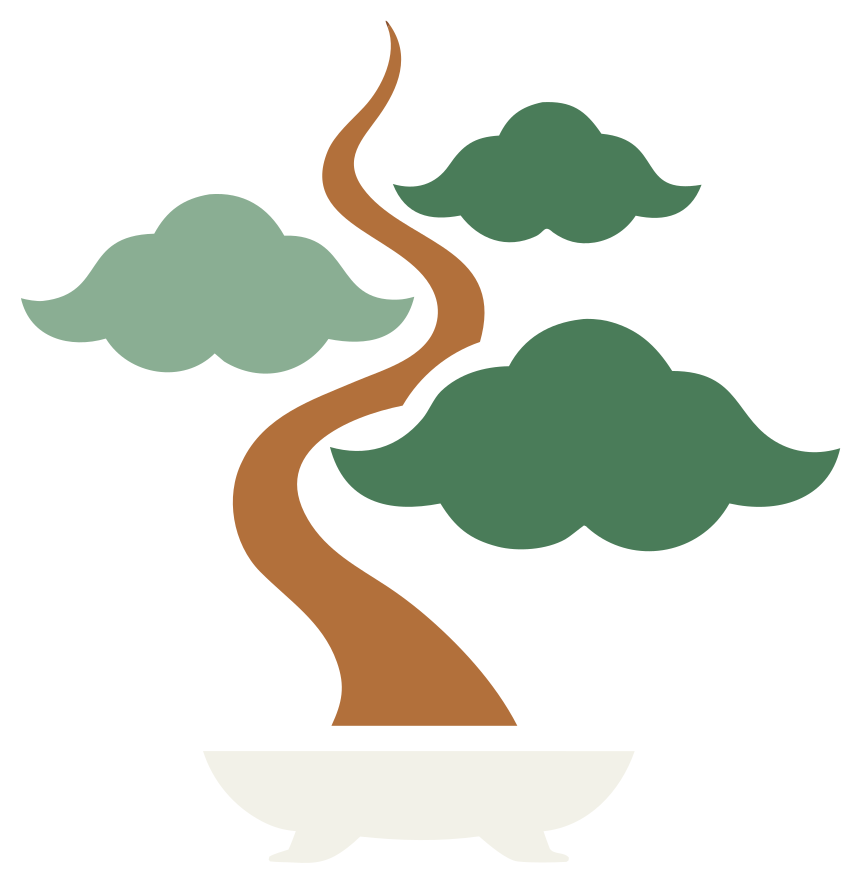
Moyogi
Informal upright is the most common bonsai style, and honestly, it's the most natural-looking. The trunk curves gently as it rises — S-curves, C-curves, subtle bends — mimicking a tree that grew through shifting light, occasional shade, or mild wind. Unlike formal upright's rigid precision, moyogi feels relaxed and organic.
The defining rule: no matter how much the trunk wanders, the apex always finishes directly over the base. That vertical relationship between root flare and crown is what makes the tree look balanced rather than falling over. The trunk can take a scenic route getting there, but the destination is directly above the starting point.
This is the style to point every beginner toward. Most nursery stock already has some natural trunk movement, so you're working with the tree's existing character instead of forcing it into a template. It's also the most versatile style for exhibition — a really well-executed moyogi can compete at any level, from local club shows to national displays.
The anatomy
What makes a informal upright read as one — judge any tree against these rules.
How to build it
Choose material with existing trunk movement. This is non-negotiable if you want good results in under a decade. A straight trunk can be bent while young using heavy 3-4mm wire, but it's so much easier to start with a tree that already curves. Look for taper, interesting bark texture, and branches emerging from the outsides of the existing bends.
Wire the trunk to refine its curves using 2-3mm anodized aluminum. You want each successive curve tighter and shorter than the one below it — this decreasing rhythm is what creates the natural, "settled" look. Avoid making the curves too uniform; a little randomness reads as authentic. Wrap at 45 degrees and bend slowly, listening for cracks in the cambium.
Position the first branch on the outside of the lowest trunk curve, roughly one-third up the tree. The second branch goes on the opposite side at the next curve, slightly higher. The third branch goes toward the back for depth. Alternate left, right, and back as you move up, always placing branches at the outside of curves. Strip out anything growing from the inside of bends, growing straight up (suckers), or crossing another branch.
Build foliage pads over multiple growing seasons by repeated pinch-and-grow cycles. Let shoots extend to four to six nodes, cut back to two, wait for two new shoots. Each pad should be gently convex on top and flat or concave underneath. Leave clear gaps between pads so the trunk's curves remain visible from every angle. The trunk line is what makes this style work — it's the spine of the whole design.
Best species for Informal Upright
Fast-growing and highly responsive to wiring. Develops fine ramification and beautiful flaking bark.
Natural trunk movement with stunning seasonal foliage color. The go-to deciduous species for this style.
Tolerates heavy bending and wiring. Dense foliage makes building defined pads straightforward.
Vigorous growth builds taper fast, and the roots fuse nicely for strong nebari.
Tropical growers' best option -- aerial roots add character, and the trunk thickens quickly.
Gorgeous flowers on a naturally curved trunk. Satsuki varieties are bred specifically for bonsai.