Bonsailist
SpeciesCategoriesGuidesQuestionsToolsStylesAbout
Bonsailist

The field guide for your first bonsai — care with real numbers, honest species picks, and tools that do the math for you.

Browse

  • All Species
  • Categories
  • Bonsai Styles
  • Compare Species

Learn

  • Care Guides
  • Bonsai Tools
  • Common Questions
  • Best For
  • Climate Zones

About

  • About Us
  • Sitemap
© 2026 BonsaiList. All rights reserved.
Privacy PolicyTerms of ServiceAccessibility
  1. Home
  2. /
  3. Guides
  4. /
  5. Bonsai Fertilizer Guide
Field guide

Bonsai Fertilizer Guide

Bonsai live in tiny pots with barely any soil. They depend entirely on you for nutrition, and a starved tree declines so gradually you might not notice until it's too late.

On the benchorganic fertilizer cakesliquid fertilizerfertilizer basketsmeasuring spoon

On this page

  1. N-P-K, and what the label actually tells you
  2. Organic or chemical — and what a season costs
  3. How much, exactly
  4. A seasonal plan
  5. Feeding for growth, feeding for refinement
  6. How feeding changes by species
  7. When it goes wrong
  8. A dead-simple routine that works
  9. Quick feeding sheet

A bonsai pot holds maybe two cups of inorganic substrate. There's no earthworm activity, no decomposing leaf litter, no vast root network mining minerals from deep soil — granular bonsai mix contains almost no nutrition at all (the bonsai soil guide explains why that's a feature). Every nutrient your tree uses comes from what you provide. Skip fertilizing for a season and the decline is subtle: slightly smaller leaves, shorter internodes, paler color. Skip it for a year and the tree is running on fumes.

N-P-K, and what the label actually tells you

Nitrogen (N) fuels leaves and shoots. Phosphorus (P) supports root development and flowering — though the "more P = more flowers" pitch on bloom-booster labels overstates it badly; trees need far less phosphorus than those products deliver. Potassium (K) strengthens cell walls and disease resistance. A balanced 10-10-10 covers most species through the growing season, and chasing exotic ratios matters much less than feeding consistently.

Those three numbers are percentages by weight, and that's worth ten seconds of attention. A 10-10-10 is 10% actual nitrogen; a 24-8-16 synthetic — standard Miracle-Gro — packs nearly two and a half times the nitrogen into the same teaspoon. Identical dose, very different meal, which is why "dilute to half strength" isn't fussiness. It's arithmetic. Organic cakes and pellets run far weaker, single digits across the board, and that's a big part of why they're so hard to overdo.

Organic or chemical — and what a season costs

Organic fertilizers — rapeseed cake, fish meal, bone meal — release slowly as soil microbes break them down: gentler feeding with almost no risk of root burn. The downside is a few days of smell and the occasional fungus gnat; mesh fertilizer baskets keep things tidy. Chemical fertilizers are precise and odor-free: slow-release pellets like Osmocote feed for three to four months, and liquid feeds work well diluted to half the label strength. Full-strength chemical fertilizer on two cups of soil with no buffering is a fast track to scorched roots.

What the options look like in dollars, for a bench of three to six trees:

  • Biogold Original: the classic Japanese organic pellet, gentle and nearly foolproof. Roughly $25–35 for a bag that lasts a full season. The premium buys consistency, not magic.
  • Generic rapeseed or soybean cakes: the same slow-release idea at $10–15 a season. Smellier, and squirrels occasionally steal them — mesh baskets fix that.
  • Osmocote (get the "Plus" version, which adds micronutrients): $12–18 for a jar that lasts two or three seasons. One light scatter in spring feeds for months. Least control, least effort.
  • Fish emulsion (5-1-1): liquid organic, $10–15 a quart, very forgiving. Reeks for a day after application.
  • Miracle-Gro at half strength: yes, it works — growers with impressive trees use it. About $10 for a box that lasts years. The tree doesn't care about branding; it cares about consistency.

How much, exactly

Feeding plannerdose + this month
What kind of tree?
Pot length, longest side (sets the cake count)
Feeding with?
The tree's job right now?
The month? (set to today)
Anything apply right now?

Dose by pot size, not by tree age or by how sorry you feel for the tree. For organic cakes and pellets: one cake — or a level teaspoon of small pellets like Biogold — per 4 inches (10 cm) of pot length, spaced around the rim and replaced every four to six weeks through the season. Each watering dissolves a little and carries it to the roots. For liquid feeds: half label strength, which for most powdered synthetics works out to about 1/2 teaspoon per gallon of water, applied every two to four weeks in place of a normal watering.

Bench rule

When in doubt, halve the dose and keep the schedule — bonsai starve slowly but burn fast.

A seasonal plan

  1. Early spring: start feeding as growth begins — a slightly higher-nitrogen formula (something like 10-6-6) fuels the first flush.
  2. Summer: stay balanced, roughly 10-10-10, at label-or-lighter doses.
  3. Fall: ease off the total amount as growth slows. Tradition says switch to a zero-nitrogen 0-10-10 to "harden off" growth — but growers genuinely disagree on this one. Many respected professionals now feed a balanced fertilizer at reduced doses right through fall, since trees still use some nitrogen while storing energy. Either approach works in practice; the point is less food, not a magic ratio.
  4. Winter: stop entirely once outdoor deciduous trees drop leaves. Indoor tropicals keep getting light feeding year-round — details in the indoor growing guide — and dormant-season care is covered in the winter care guide.

Feeding for growth, feeding for refinement

Here's the real reason growers argue about ratios: they're feeding trees with different jobs. A trunk you're trying to thicken and a finished maple you're trying to keep delicate need opposite regimes, and most fertilizer advice never says which tree it's talking about.
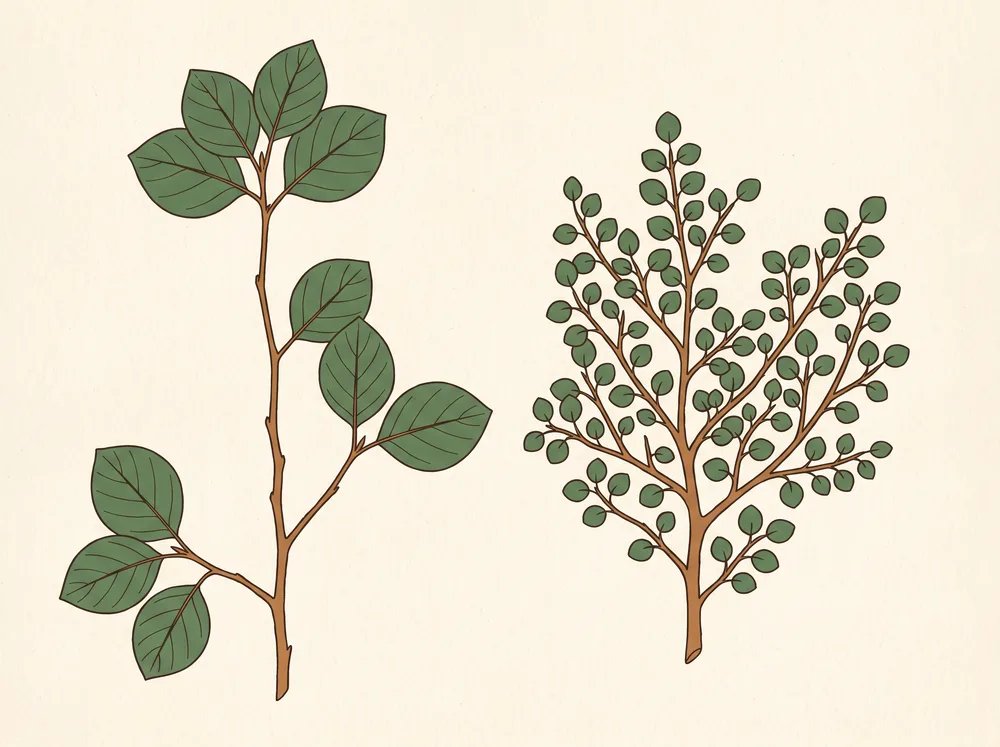
Botanical illustration comparing a coarse long-internode shoot with a densely ramified short-internode branch
What the fertilizer decides. Left: development growth — long internodes, coarse shoots, fed hard all season. Right: refinement growth — short internodes, dense ramification, fed lean after the flush hardens.

Development (young material — thickening trunks, building primary branches): feed hard. Full organic doses from early spring through October, plus half-strength liquid every week or two during peak growth. Long internodes and coarse shoots are fine — you'll cut them off anyway. This is where trunks get built.

Refinement (mature trees — small leaves, short internodes, dense ramification): hold spring feeding until the first flush has hardened off — leaves darkened and stiffened, roughly four to six weeks after bud break — then feed lean and steady. An unfed spring flush stays tight; a heavily fed one produces exactly the coarse growth you spent years eliminating.

Switch regimes when the trunk reaches its target thickness and the primary branches are set. Trees can move back, too — a refined tree that's lost vigor goes on the development menu for a season.

How feeding changes by species

  • Pines: Japanese black pine and white pine get lean nitrogen — heavy spring feeding grows needles long and wrecks the scale. Feed lightly in spring, more generously after summer work.
  • Azaleas: satsuki azalea grows in straight kanuma and wants an acid-formulated feed. Hard, alkaline tap water slowly raises soil pH until iron locks out — if your kettle furs up with scale, use a fertilizer for acid-loving plants and expect to correct chlorosis now and then.
  • Junipers: junipers are steady, unfussy feeders — balanced food from spring through fall, no drama. Underfeeding shows as pale, weak foliage long before anything dies.
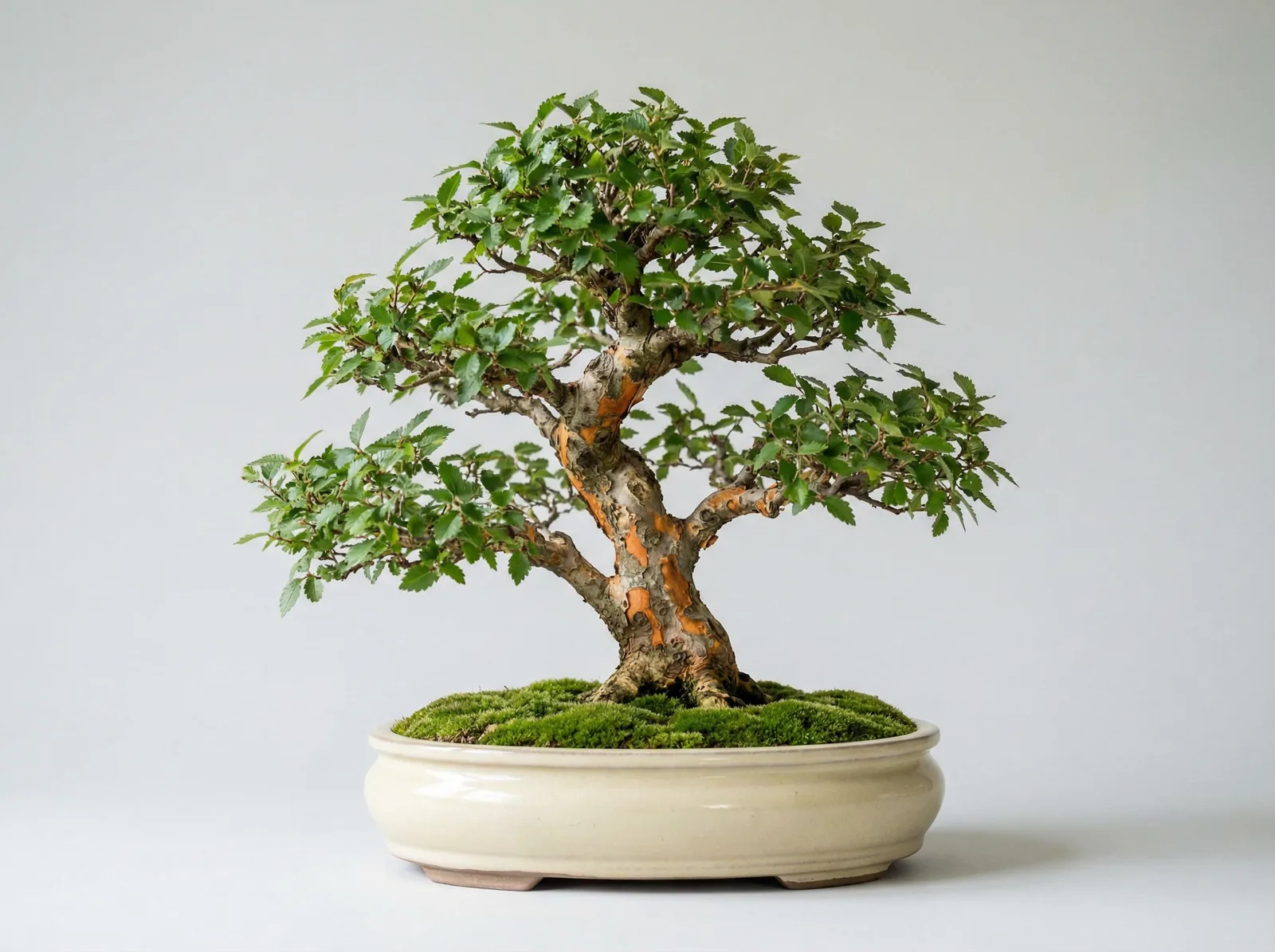
  • Trees in development: Chinese elm and ficus being pushed for trunk size will use everything you give them — full development regime, with visible payoff inside a season.
  • Flowering and fruiting species: crabapple, wisteria, and pomegranate pause feeding while in bloom — food during flowering pushes the tree back toward leaves and shortens the display. Resume once the flowers drop.
  • Succulents: dwarf jade and true jade store everything and need little — monthly at half strength through the warm months is plenty, nothing in winter.

When it goes wrong

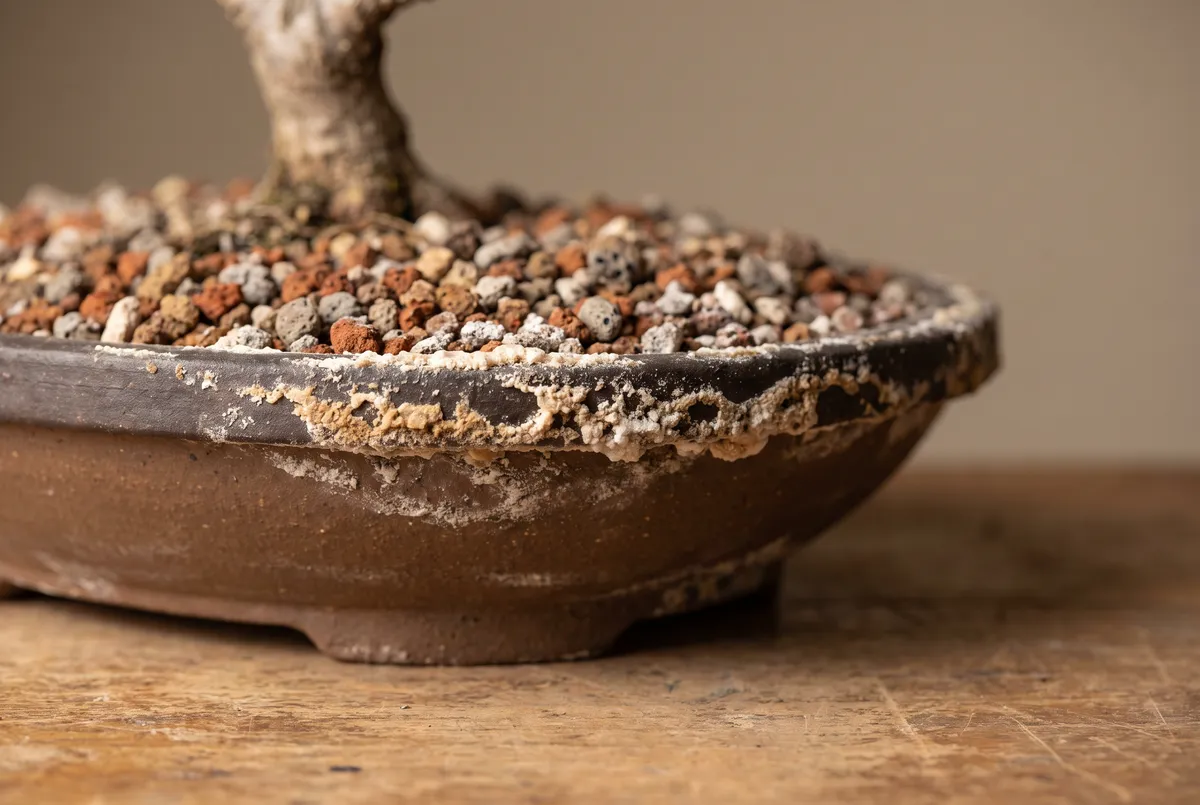
Overfed. The signs, in the order you'll notice them: a white or tan crust on the soil surface and pot rim (fertilizer salts left behind by evaporation), brown crispy leaf tips and margins, and — the confusing one — wilting even though the soil is moist. Concentrated salts around the roots pull water out of the tree by osmosis; the roots are sitting in water they can't drink.
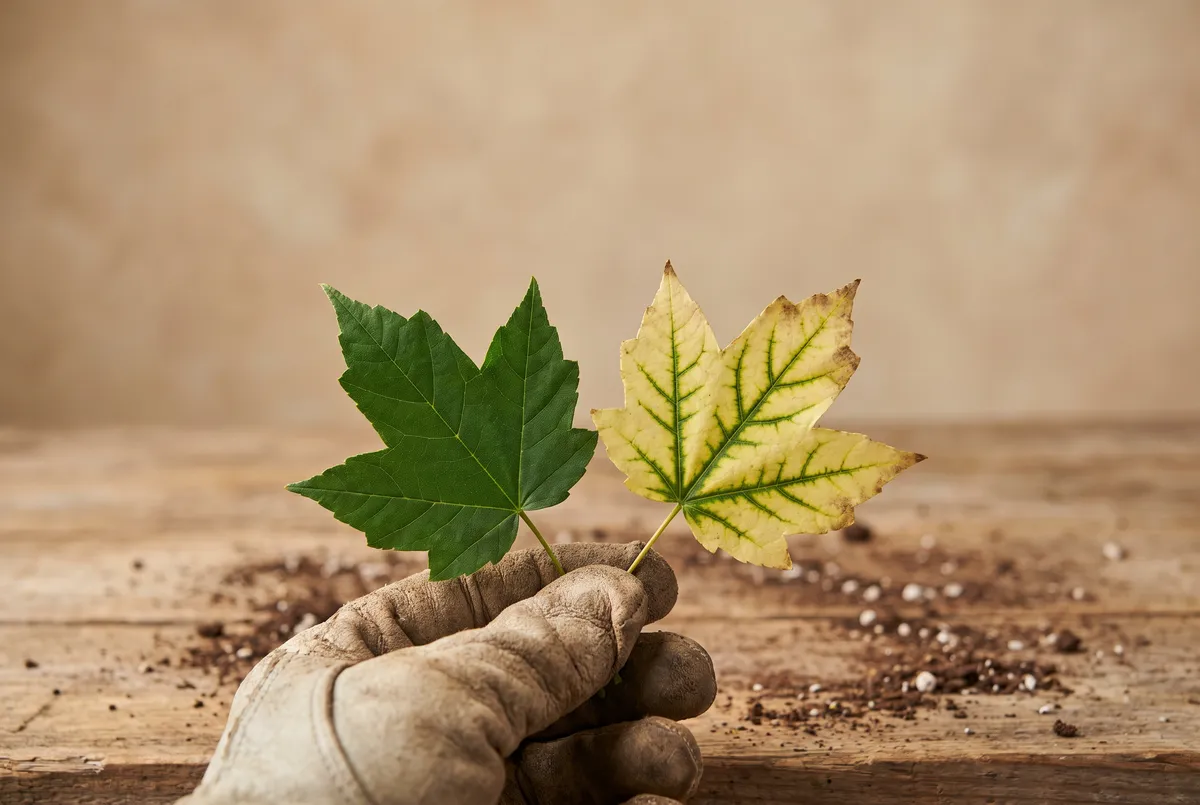
Hand holding a healthy green maple leaf next to a chlorotic yellow leaf with green veins
Left: healthy. Right: interveinal chlorosis — yellow between green veins is iron, not nitrogen. Chelated iron corrects it in about two weeks.
Close-up of white fertilizer salt crust on the rim and granular soil surface of a bonsai pot
The overfed tell: fertilizer salts left behind as water evaporates. See this crust, flush with 3–4 pot volumes of plain water and stop feeding for a month.

Bench rule

See white crust or fresh brown leaf tips? Flush the pot with 3–4 pot volumes of plain water poured slowly through, then stop fertilizing for a month.

The flush dissolves the salts and carries them out the drainage holes — good granular soil makes this nearly foolproof, one more argument for a free-draining mix. Brown tips have other causes too; the brown leaves rundown separates them.

Underfed. Uniformly pale leaves, smaller with each flush, and weak extension growth. Nitrogen is mobile inside the tree, so the oldest leaves yellow first while new growth stays greenish — the reverse of most watering problems. The yellow leaves guide covers the full differential.

Micronutrients. Iron, manganese, zinc, magnesium. Interveinal chlorosis — yellow leaves with green veins — almost always means iron deficiency, and a chelated iron supplement corrects it within a couple of weeks. Quality organic fertilizers include trace minerals; if you run pure chemical feed, pick a formulation labeled "complete with micronutrients."

And when not to feed at all. Never feed a tree that's stressed, freshly repotted, or fighting an infestation. Fertilizer pushes growth, and a struggling tree needs its energy for healing — the pest guide covers getting a sick tree stable first. After repotting, wait a full month. After heavy pruning, give it two to three weeks. And water before you feed: fertilizing dry soil concentrates salts against roots with no water to buffer them — water thoroughly first, feed second.

Never

Never fertilize a bone-dry tree or one repotted within the past month — dissolved salts pull water out of dry or freshly cut roots by osmosis, burning exactly the fine feeder roots the tree needs to recover.

A dead-simple routine that works

Place Biogold or similar organic cakes on the soil surface in early spring — one per 4 inches of pot. Replace them every four to six weeks through October, tapering the amount in fall. Optionally add half-strength liquid feed every two weeks during peak growth on trees you're pushing hard (the development regime above). That covers 95% of bonsai without overthinking.
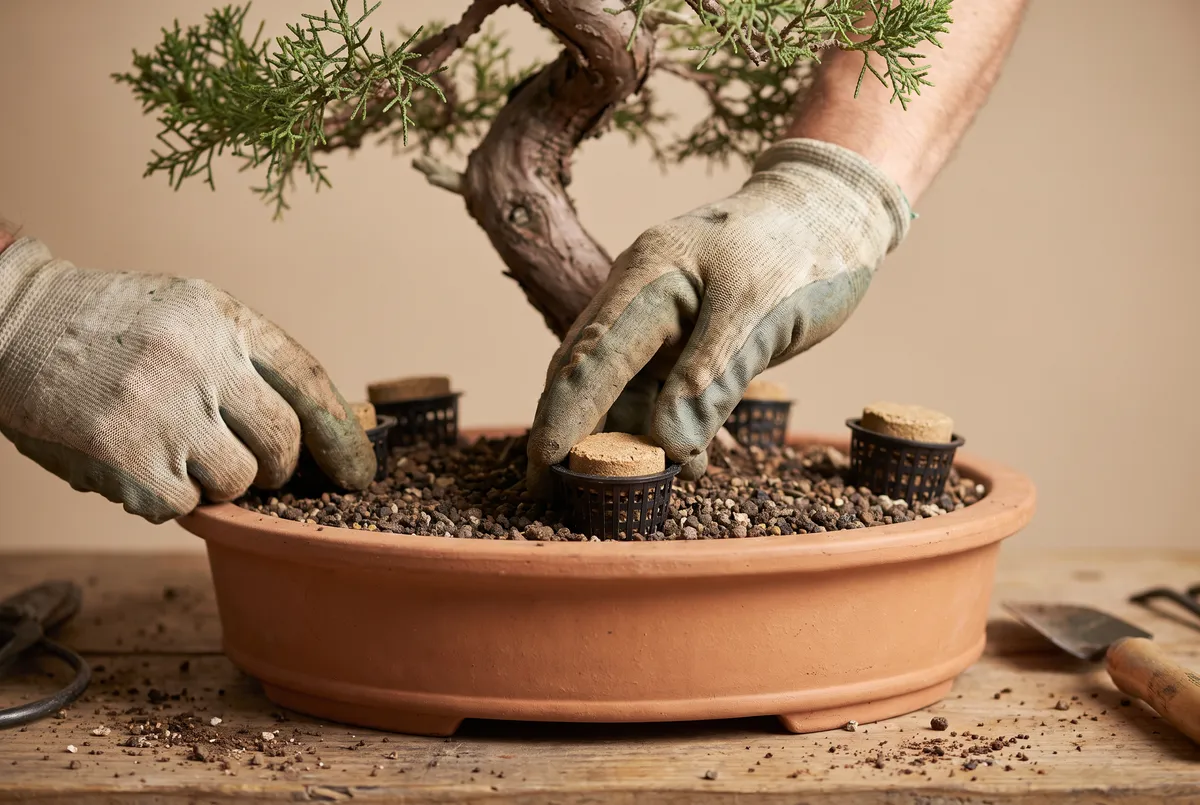
Hands placing organic fertilizer cakes in mesh baskets around the rim of a bonsai pot
One cake per 4 in (10 cm) of pot length, spaced around the rim in mesh baskets — never piled against the trunk. Each watering dissolves a little and carries it down.

Quick feeding sheet

  • Growing season: feed every 2–4 weeks (liquid at half strength) or keep organic cakes on the soil, replaced every 4–6 weeks.
  • Dose: one cake or a teaspoon of pellets per 4 inches of pot length; liquid at about 1/2 teaspoon per gallon.
  • Spring: a bit more nitrogen. Fall: less food overall — exact ratio is a debated detail.
  • Winter: nothing for dormant outdoor trees; light monthly feeding for indoor tropicals.
  • Development trees: feed hard all season. Refinement trees: wait for the spring flush to harden, then feed lean.
  • Never feed: freshly repotted (1 month), heavily pruned (2–3 weeks), sick, or bone-dry trees.
  • White crust or brown leaf tips = overfed: flush with 3–4 pot volumes of water, pause a month.
  • Yellow leaves with green veins = iron, not nitrogen.

Bonsai Fertilizer Guide: FAQ