Bonsailist
SpeciesCategoriesGuidesQuestionsToolsStylesAbout
Bonsailist

The field guide for your first bonsai — care with real numbers, honest species picks, and tools that do the math for you.

Browse

  • All Species
  • Categories
  • Bonsai Styles
  • Compare Species

Learn

  • Care Guides
  • Bonsai Tools
  • Common Questions
  • Best For
  • Climate Zones

About

  • About Us
  • Sitemap
© 2026 BonsaiList. All rights reserved.
Privacy PolicyTerms of ServiceAccessibility
  1. Home
  2. /
  3. Guides
  4. /
  5. Bonsai Pest & Disease Guide
Field guide

Bonsai Pest & Disease Guide

Spider mites, aphids, scale, and fungal infections hit bonsai hard and fast. Early detection and proper treatment save trees — here's what to watch for.

On the benchneem oilinsecticidal soapspray bottleold toothbrushrubbing alcoholcopper fungicidemagnifying glass

On this page

  1. Match the symptom first
  2. Spider mites
  3. Aphids, whiteflies, and the ants that farm them
  4. Scale, mealybugs, and caterpillars
  5. Fungus gnats: the mall-bonsai pest
  6. Mixing sprays, and when to escalate
  7. Fungal problems, species by species
  8. Root rot: the six-step emergency
  9. The daily habit, quarantine, and the quick sheet

Before you treat for bugs, check whether there are any: most "sick" bonsai have no pests at all — the usual culprits are overwatering, underwatering, or too little light, and no spray fixes those. If leaves are yellowing or dropping and you can't find insects, webbing, or sticky residue, start with why is my bonsai dropping leaves and the watering guide before reaching for the neem oil.
Bench rule

If two minutes of searching turns up no insects, no webbing, and no sticky film, put the spray down — treat it as a watering or light problem instead.

Match the symptom first

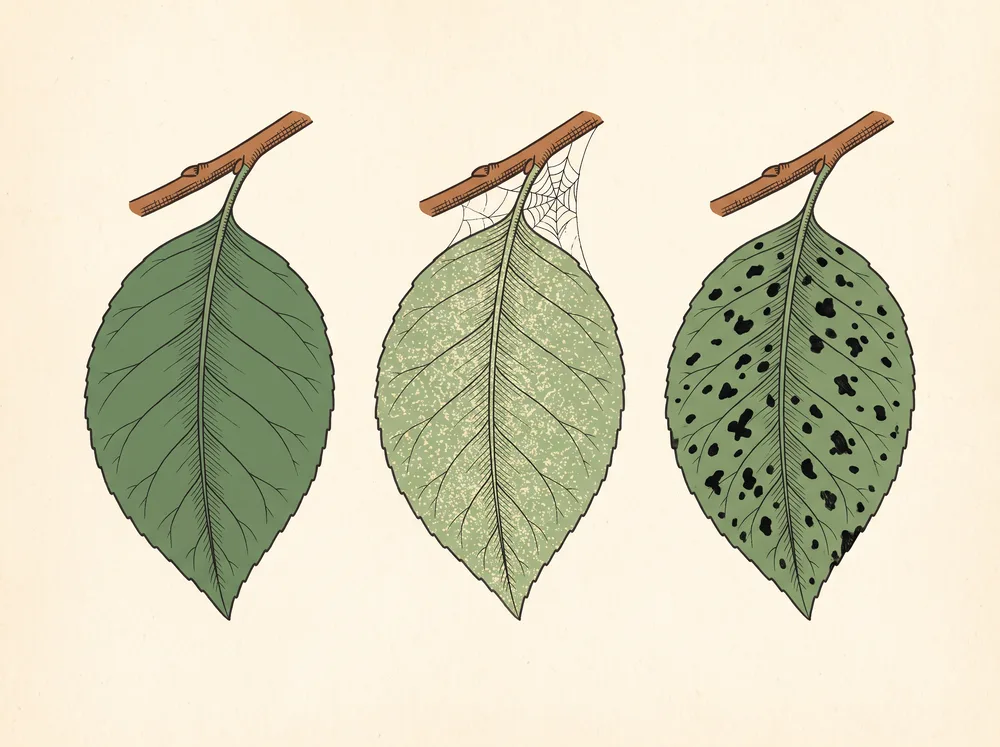
Botanical illustration comparing a healthy leaf, a mite-stippled leaf, and a leaf with fungal black spot
Left to right: healthy, spider-mite stippling, fungal black spot — the two leaf signatures that call for treatment instead of a watering fix.
Pest identifiertwo answers
Where's the trouble?
What do you see?

Pick a location first — the options narrow to match.

  • Fine webbing between branch tips; stippled, bronzed leaves → spider mites. Confirm with the paper test below, then water-blast and run a three-round spray cycle.
  • Sticky film on leaves; clusters of small green, black, or white insects on new shoots → aphids. Confirm by eye — they don't hide — then water blast and insecticidal soap.
  • Tiny white moths fluttering up when you shake a branch → whiteflies. Confirm with a yellow sticky card; soap every five to seven days.
  • Hard brown or tan bumps on bark → scale. Bark doesn't scrape off with a fingernail; scale does. First move: rubbing alcohol and a toothbrush.
  • White cottony tufts in branch crotches → mealybugs. First move: alcohol swab, then soap.
  • Small dark flies rising from the soil when you water → fungus gnats. The flies come from the pot, not the foliage. First move: drier cycles plus BTI.
  • Chewed leaf edges or whole sections gone overnight → caterpillars. Check leaf undersides and hand-pick.
  • Black leaf spots or a powdery white coating → fungal problem. First move: remove affected leaves, fix the airflow.
  • Yellowing leaves, soil that stays wet and smells sour, mushy trunk base → root rot — a watering problem, not a pest; the six-step emergency is below.
  • Dropping leaves with none of the above → almost certainly light or watering; take the leaf-drop question first.

A healthy tree with good light, correct watering, and moving air rarely gets seriously infested. Most infestations start on a tree already weakened by something cultural — fix the conditions and you prevent 80% of pest problems before they start.

Spider mites

The number-one bonsai pest, bar none — especially indoors. They're nearly invisible, so confirm with the paper test: hold white paper under a branch, tap sharply, and watch. Moving specks the size of a period are mites; a smeared reddish-brown streak settles it. Run it monthly on junipers even when they look fine — mites can bronze half a juniper before you'd spot one.
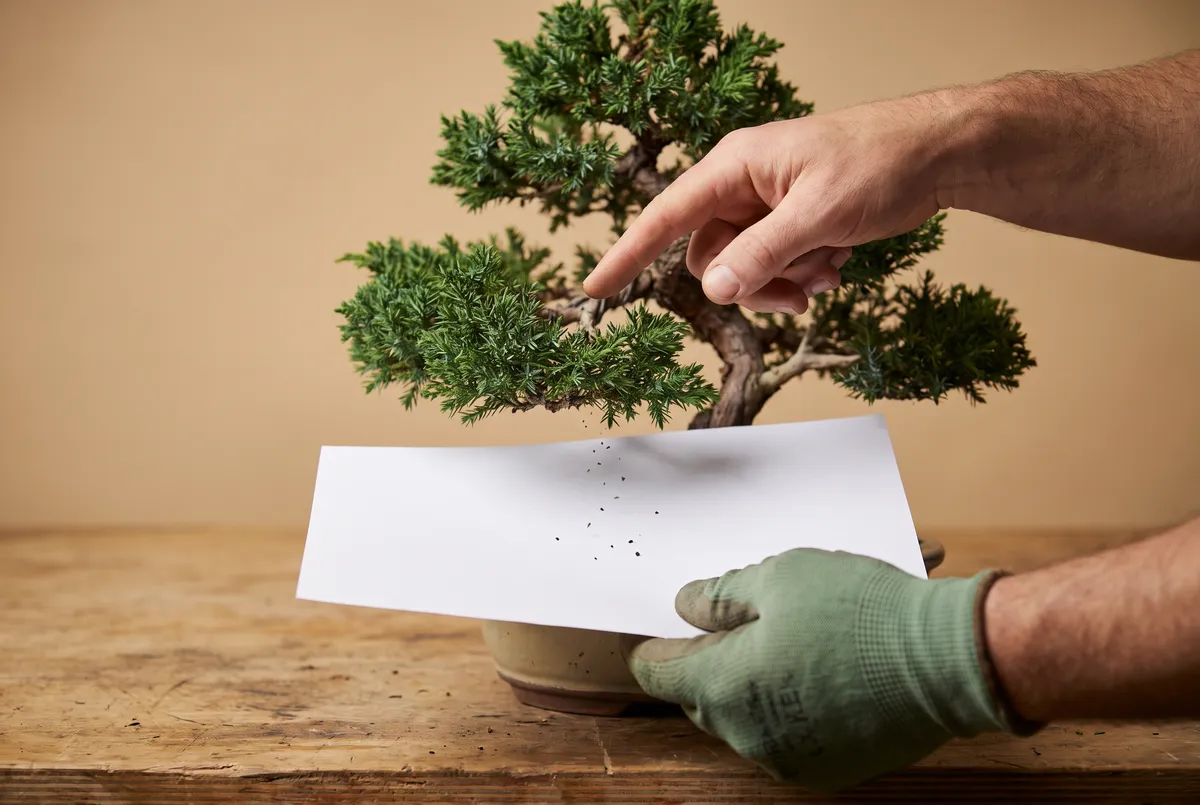
Hands tapping a juniper bonsai branch over a sheet of white paper to check for spider mites
The paper test: one sharp tap over white paper — specks that <em>walk</em> are spider mites, and a reddish smear when you wipe a finger across them settles it.

Mites love warm, dry, stagnant air — most living rooms in winter (the indoor growing guide covers airflow and humidity fixes). First response: blast the entire tree with a strong stream of water, flipping leaves to hit the undersides. Then spray neem oil or insecticidal soap every five to seven days for three consecutive treatments.

Bench rule

Whatever you spray, spray three times, five to seven days apart — each application kills active pests but not their eggs, and a single round guarantees a rebound.

Aphids, whiteflies, and the ants that farm them

Aphids are soft-bodied little green, black, or white bugs clustering on tender new growth. They suck sap and excrete sticky honeydew that grows sooty mold. A strong water spray knocks light populations off immediately; heavier infestations take insecticidal soap every seven days for two to three weeks. Outdoor trees get free help from ladybugs and lacewings, which eat aphids by the hundreds.

Whiteflies favor the same indoor tropicals — ficus, schefflera — and scatter when disturbed, so sprays miss the adults. A yellow sticky card ($5–8 a pack) catches adults; soap every five to seven days for three weeks clears larvae on the leaf undersides.

Check outdoor trees for ants marching up the trunk: they farm aphids for honeydew and defend them from ladybugs. A sticky barrier around the pot feet breaks the escort.

Scale, mealybugs, and caterpillars

Scale insects look like tiny brown or tan bumps glued to branches and trunks — mistaken for bark texture all the time, which is how they get out of control. Scrape them off with a toothbrush dipped in rubbing alcohol, then follow with neem oil to catch the crawlers (the mobile juvenile stage) you missed. Recheck weekly for at least a month; a few survivors restart the colony.
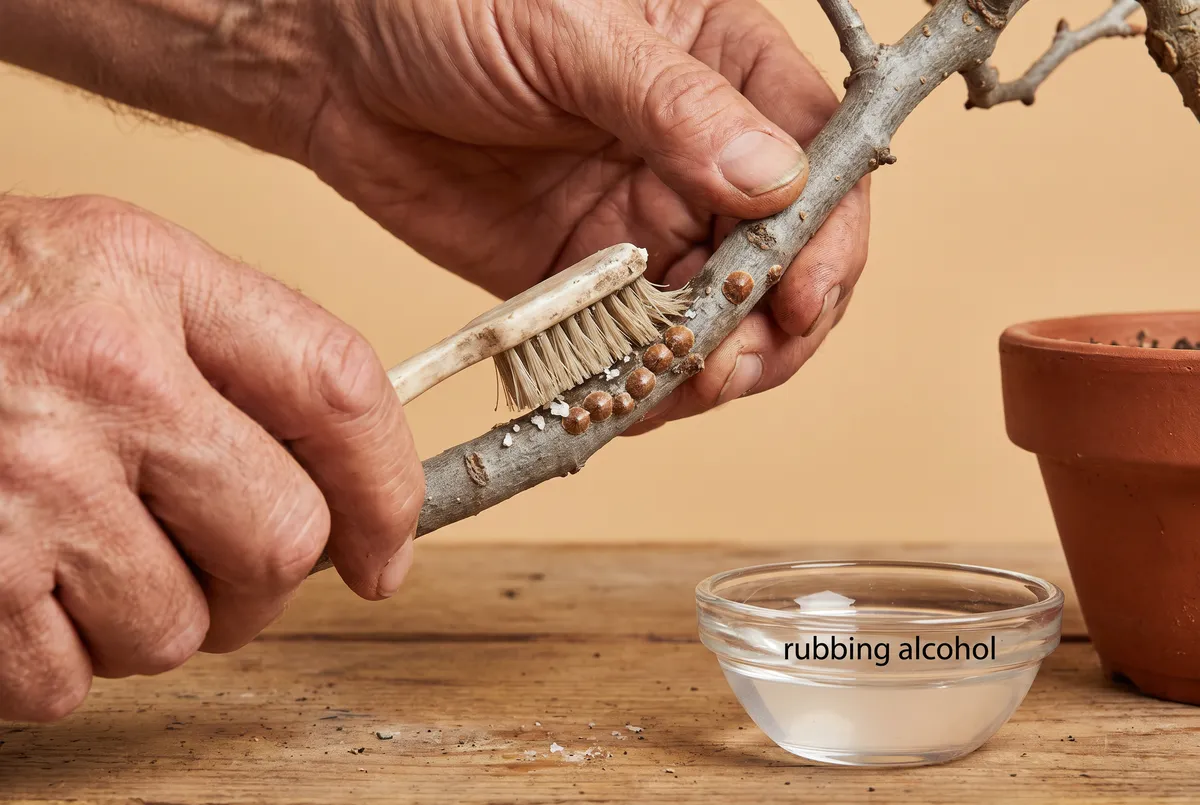
Hands scrubbing brown scale insects off bonsai bark with a toothbrush, dish of rubbing alcohol nearby
Scale passes as bark texture — the bumps scrape off with a fingernail, bark doesn't. Alcohol scrub first, then neem for the crawlers you missed.

Mealybugs show as cottony white tufts in branch crotches, favoring indoor tropicals — ficus, jade, and schefflera especially. Dab each with an alcohol-soaked cotton swab, then spray the whole tree with insecticidal soap. Check again in a week; they hide in crevices and almost always need a second round.

Caterpillars are the easiest fix here: hand-pick and relocate — a few chewed leaves won't hurt an established tree. The exception is the bagworm, a 1–2 inch cone of silk and foliage on junipers and other conifers. Pick the bags off in fall or winter; each holds hundreds of eggs.

Fungus gnats: the mall-bonsai pest

If your tree came home from a mall kiosk or big-box store in dense black potting soil, expect these. The adults are harmless; the larvae live in constantly wet organic soil, feeding on fungus and, when heavy, fine roots. The soil is the real problem, not the fly.

Break the cycle from both ends. Let the top half inch (13 mm) of soil dry before rewatering — larvae can't survive dry cycles — and add BTI (Bacillus thuringiensis israelensis — mosquito dunks, $10–15 a season): crumble a quarter dunk onto the soil or steep one in the watering can — larvae-specific, harmless to the tree and pets. Sticky cards catch the adults.

Bench rule

If fungus gnats appear within days of bringing a tree home, the soil is the infestation — repot into granular bonsai mix at the next safe window instead of fighting flies all year.

Mixing sprays, and when to escalate

The standard neem mix: 1–2 teaspoons of neem concentrate plus a few drops of dish soap (the emulsifier) per quart of warm water, shaken often because it separates fast. A $12–15 bottle lasts a year. Insecticidal soap comes premixed for $8–12; growers genuinely disagree about DIY dish-soap sprays — detergents can strip the leaf's waxy cuticle — so premixed is the safer bet.

Coat every surface, especially leaf undersides, at dusk or on an overcast morning. Indoor trees go to the shower, tub, or outside — spray, drip-dry, return.

Never

Never spray oil or soap above 85°F or in direct sun — the film blocks transpiration and traps heat, scorching the leaves you just coated.

Tender species need a test patch: Fukien tea and serissa can drop leaves at full-strength neem. Spray one branch, wait 48 hours, check for burn before treating the whole tree.

When three full rounds of contact spray fail — armored scale is the usual holdout — escalate to a soil-applied systemic: imidacloprid granules ($15–25 a jar), dosed by pot size per the label. It moves through the sap and reaches pests no surface spray can touch.

Never

Never use imidacloprid on an outdoor flowering species — azalea, crabapple, wisteria — because the systemic moves into nectar and pollen and kills the bees working the flowers.

Fungal problems, species by species

Fungal issues usually signal a cultural problem: too much moisture, too little airflow. Remove affected leaves and fix the conditions — better drainage (see the soil guide), less frequent watering, a small fan. Persistent cases respond to copper-based fungicide at the exact label dilution. The big three, by species:

  • Juniper: tip blight — branch tips brown from the tip inward in spring and early summer. Prune affected tips back to healthy green and wipe the shears with rubbing alcohol between cuts — dirty blades spread the spores.
  • Japanese maple: powdery mildew — a white dusting on leaves in late summer. An airflow disease: space trees apart on the bench and keep evening water off the foliage.
  • Chinese elm: black spot — dark spots, then yellowing, dropping leaves. Remove affected and fallen leaves and bin them (don't compost), water the soil rather than the leaves, and use copper fungicide if it persists.

Root rot: the six-step emergency

Roots need oxygen as much as water; waterlogged soil suffocates them, and rot spreads from dead roots to healthy tissue. This is the one time repotting a sick tree is correct — the repotting guide explains why sick trees otherwise stay in their pots.
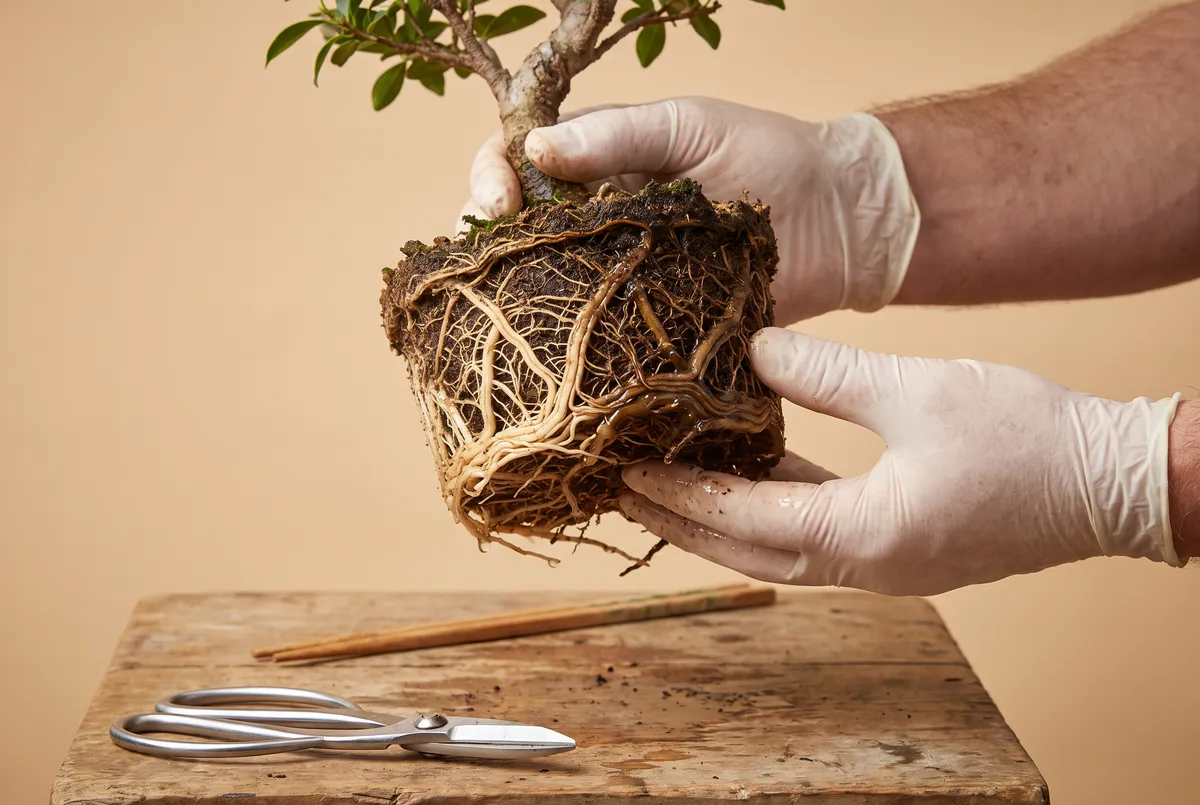
Hands holding a rinsed bonsai root ball showing healthy pale roots beside dark rotted ones
The root verdict in one look: firm and pale is alive, dark and mushy is gone — cut back to firm tissue even if it costs half the root mass.
  1. Pull the tree from its pot and gently clear the old soil with a chopstick.
  2. Rinse the root mass under tepid water so you can see what's alive.
  3. Cut every mushy, brown, foul-smelling root back to firm white or tan tissue with clean, sharp shears — losing half the root mass beats leaving any rot.
  4. Repot in fresh, fast-draining granular mix — the soil calculator has the ratio for your species type — and keep it slightly on the dry side.
  5. No fertilizer for four to six weeks. Damaged roots can't use it, and the salts burn what's left.
  6. Park the tree in bright shade out of the wind and wait weeks — judge progress with the scratch test in is my bonsai dead, not by staring at it daily.

The daily habit, quarantine, and the quick sheet

Build a 30-second inspection into watering: flip a few leaves, scan branch junctions, glance at the soil surface. Catching five aphids is a two-minute fix. Catching five hundred is a two-week battle with real risk to the tree.

Every new tree gets two to three weeks of isolation from your collection, with close inspection every few days. Nurseries and shows are hotbeds for hitchhiking pests, and one infested newcomer can seed spider mites across a whole bench before anything looks wrong.

The whole guide in ten lines:
  • Confirm before treating: no visible pest, webbing, or stickiness = watering or light problem
  • Spider mites: paper-tap test → hard water blast → neem or soap, 3 rounds, 5–7 days apart
  • Aphids and whiteflies: water blast or sticky cards → soap weekly for 2–3 weeks
  • Scale: alcohol scrub → neem for crawlers → recheck weekly for a month; systemic if 3 rounds fail
  • Mealybugs: alcohol swab each tuft → whole-tree soap → recheck in a week
  • Fungus gnats: drier cycles + BTI dunks → repot into granular soil at the next window
  • Fungal spots or mildew: remove leaves, add airflow, copper fungicide at label dilution
  • Root rot: the six steps above, then hands off for weeks
  • Neem mix: 1–2 tsp concentrate + a few drops of dish soap per quart; never above 85°F or in sun
  • New trees: 2–3 weeks of quarantine, no exceptions

Bonsai Pest & Disease Guide: FAQ