Watering is the single most important skill in bonsai. Master this one thing and your tree will forgive almost everything else you get wrong.
On the benchwatering can with fine rosehumidity trayspray bottlemoisture meter
Overwatering kills more bonsai than drought ever will. Sounds backwards, but roots sitting in waterlogged soil suffocate and rot, and by the time leaves start yellowing the damage is weeks old. So how often should you water? When the soil tells you, not when a calendar does. Rough starting points: outdoor trees in a granular mix, daily in summer and every 1-3 days in spring and fall; indoor tropicals, every 2-4 days (4-6 in winter); dormant outdoor trees, maybe weekly. How often to water a bonsai has the short version; this guide covers the technique behind it.
Three ways to read the soil
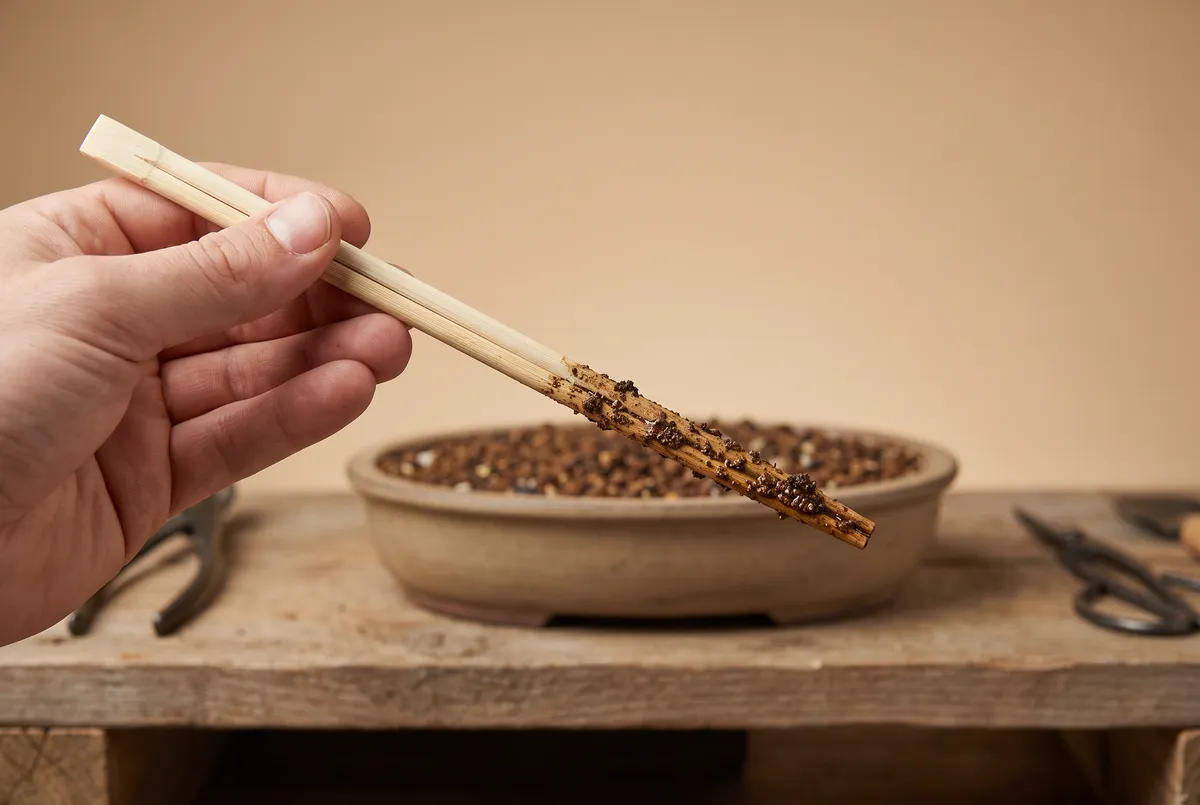
The dipstick read after ten minutes in the pot: dark and damp on the buried half means wait a day — dry and clean means water now.
The morning checktwo answers
A fixed schedule ignores everything that matters: pot size, soil mix, humidity, temperature, wind. The soil itself never lies.
The finger test. Push a finger about half an inch into the soil every day. Dry at that depth? Water thoroughly. Still damp? Check again tomorrow. This one habit saves more trees than any other advice on this site.
The chopstick test. In pots deeper than about 3 inches a finger can't reach the middle. Bury a wooden chopstick to the bottom, leave it 10 minutes, and read it like an oil dipstick: darkened and damp means wait; dry and clean means water.
The weight test. Lift the pot right after a thorough watering and memorize that heft, then lift it each morning — suddenly light means the water is gone.
If your tree came from a big-box store, recalibrate: dense potting soil or peat — standard in mall bonsai — can look dry on top while the core stays wet for 5-7 days. Test deep with the chopstick and expect long gaps between waterings. A granular akadama-pumice mix is the opposite: it dries in 1-2 days and almost can't be overwatered. The soil guide explains why that trade is worth making at the next repot.
Skip the $10 moisture meters: fine in dense potting soil, junk in a granular mix, where the probe sits half in air gaps and reads "dry" regardless. A finger is free and better calibrated.
The whole decision fits on one card — including the fork beginners miss: a wilting tree is not automatically a thirsty tree (see troubleshooting below).
How to water, step by step
Saturate the whole root mass every time — shallow watering trains roots to crowd the top inch, where they cook in summer.
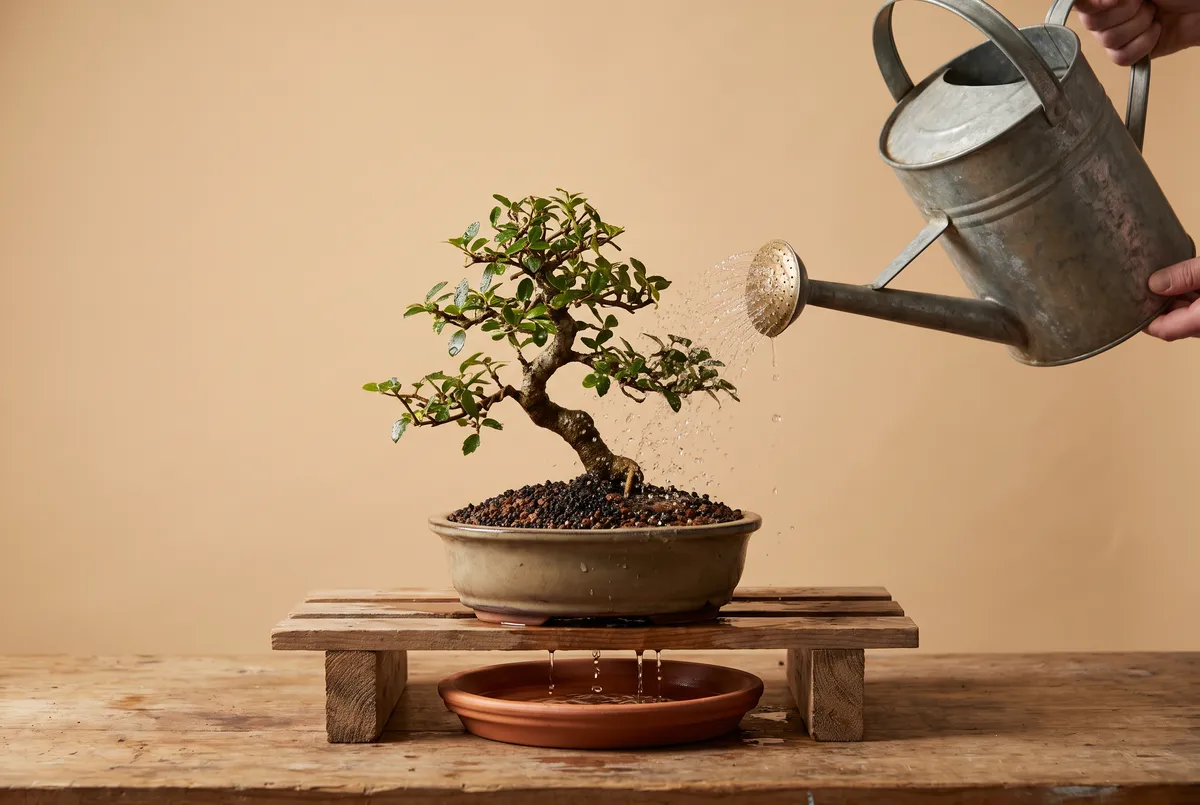
The end state, not a time or a volume: water streaming from the drainage holes — then wait sixty seconds and do it again.
Use a watering can with a fine rose head — the cap that breaks the stream into a shower; a decent one runs $12-25 — so you don't blast soil out of the pot.
Soak the entire root mass until water streams from the drainage holes — a gentle 15-30 second pour, not one quick pass.
Wait sixty seconds, then soak again. The second pass is the one most people skip: the first wets the particle surfaces, the second saturates the whole column. An 8-inch pot drinks roughly a pint to a quart across both passes.
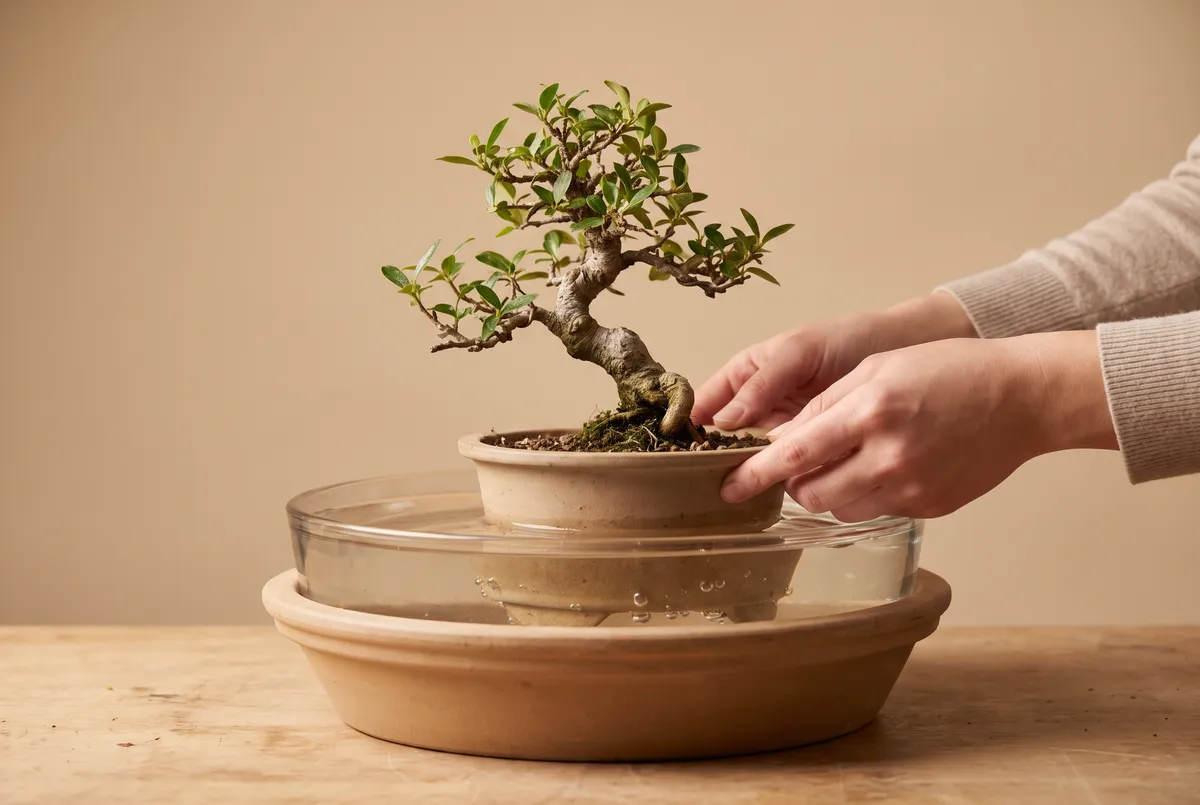
If water sheets straight off without soaking in, the substrate has gone hydrophobic. Sit the whole pot in a basin of room-temperature water for 5-10 minutes to rehydrate from below.
Species change the rhythm
Same test, different thresholds:
Juniper: moderate; let the top layer dry slightly between drinks — conifer roots want a real wet-dry cycle.
Black pine: same camp — moderate water in a fast mix, never constantly wet.
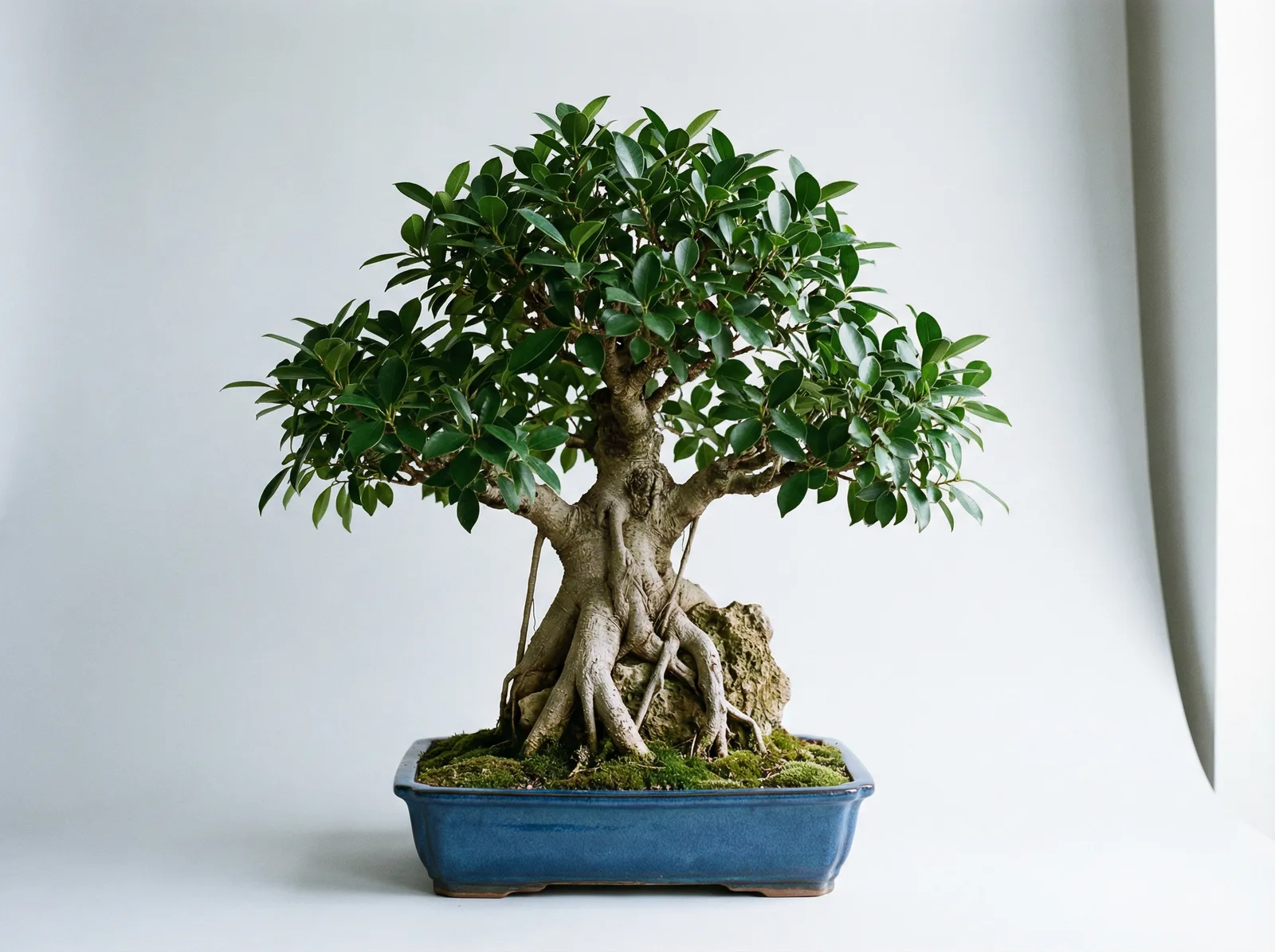
Ficus: water when the soil surface dries; the most forgiving rhythm here.
Japanese maple: consistent moisture plus shelter from hot wind, which crisps leaf edges in an afternoon.
Azalea: borderline aquatic. Keep the kanuma moist and use rainwater where you can — azaleas resent hard, limy tap water. Let it dry completely and you'll be shopping for a replacement tree; those hair-fine roots hold no reserves.
Jade: the opposite pole — a succulent, so let the soil dry completely between waterings. Same for dwarf jade.
Bald cypress: a swamp tree — keep it moist to wet; in midsummer growers stand the pot in a shallow water tray without harm; willow plays by the same rules.
What kind of water — and does misting count?
Tap water works fine for most growers. If yours is heavily chlorinated, let a bucket sit uncovered overnight — the chlorine off-gasses on its own. Rainwater is ideal if you can collect it. The one thing to genuinely avoid is softened water: the sodium accumulates in the soil and burns root tips.
Misting is not watering. A pebble tray of water under the pot adds a small bubble of humidity that tropicals like ficus and Fukien tea appreciate in winter, when indoor heating turns the air desert-dry. Misting is even more temporary — growers disagree about whether it does anything measurable. Both are supplements, never a substitute for soaking the roots.
Timing through the seasons
Water in the morning whenever possible; wet foliage going into a cool night invites fungal problems. The pace itself swings through the year:
Spring and fall, outdoors: every 1-3 days as growth ramps up or down.
Summer, outdoors in granular mix: daily, and twice daily — early morning and late afternoon — through July-August heat above 90°F.
Winter, dormant outdoor trees: they barely drink. Check every few days and water lightly only when the soil is dry a finger-depth down. The winter care guide covers the dormant season in detail.
Winter, indoor tropicals: roughly every 4-6 days — central heating dries the air; keep checking.
Your pot and soil set the pace
Two trees on one bench can need water on different days — the container is usually why. Unglazed terracotta breathes and dries faster than glazed ceramic. Shallow shohin pots lose moisture quicker than deep ones. A free-draining akadama-pumice-lava mix dries faster than anything organic — by design, because fast drying protects roots from rot. The soil calculator builds the right mix for your species; if the container itself seems to be the problem, check it with the pot size calculator.
Overwatered or underwatered? Reading a struggling tree
From across the room both failures look identical: a sad tree with off-color leaves. Up close they separate cleanly.
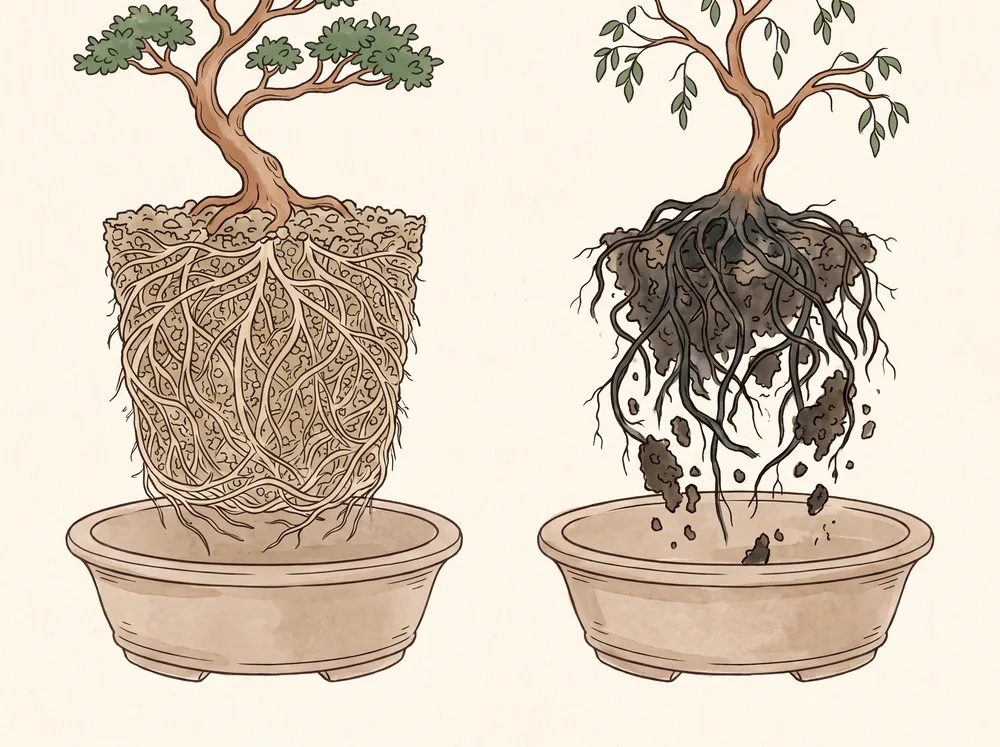
The root check: firm and pale-to-tan (left) means you caught it early — just water less; black and mushy (right) means rot and an emergency repot.
Overwatered: leaves yellow and soft, often dropping while still bendable; soil wet for days; sometimes a sour, swampy smell.
Underwatered: leaves crispy, curled, or brown at the edges; soil bone dry and pulled away from the pot walls; the pot feels light as styrofoam.
Underwatering is the fast fix: a 10-minute basin soak, then bright shade for a week — no fertilizer, no pruning. Crisped leaves won't recover, but if the branch tips are still flexible, new buds usually push within 2-4 weeks.
Overwatering takes longer because the damage is underground. Stop watering, move the tree to bright shade, and let the soil approach dryness before the next drink. Then tip the tree partway out of its pot: firm white-to-tan roots mean you caught it early — just water less. Black, mushy, sour-smelling roots mean rot, and the tree needs an emergency repot into fresh, free-draining soil — the repotting guide covers it, and root rot is the one exception to the never-repot-a-sick-tree rule. Give it 2-4 weeks before judging recovery.
Three smaller failures:
White crust on the soil or pot rim: mineral salts from hard water. Flush monthly — run two or three times your usual volume through in one session.
Water pools and sinks slowly: compacted soil or blocked drainage. Check the holes first — roots and silt clog the mesh; a crusted-over surface is a repot signal, not a watering problem.
Water races straight through, pot stays light: hydrophobic soil or a root-bound pot channeling water down the walls. Basin-soak it (step 4) and put repotting on the calendar.
A bonsai pot holds a day or two of summer water. Plan before you pack, not from the airport.
The basin soak — water halfway up the pot for 10 minutes: the fix for hydrophobic soil, the underwatered rescue, and the deep drink before you leave town.
A weekend (2-3 days): deep-soak the morning you leave — full two-pass watering or a 10-minute basin soak — then move the trees into bright shade and group the pots to slow evaporation. In spring or fall that's the whole plan; in a July heat wave, it's the honest limit.
One to two weeks: you need hardware or a human.
Drip stakes (about $10 for a set of four): spikes that meter water from an upturned bottle. Run a test week before leaving to learn the drip rate.
Wicking: a cotton rope or shoelace running from a raised basin into the soil. Crude, effective, also needs a test run.
A neighbor with a card that says one line: "Every morning, push a finger half an inch into the soil — if it's dry, water until it runs out the bottom." One line, because people follow one line.
Indoor tropicals in winter are the easy case: a deep soak plus a pebble tray buys most ficus 5-6 days away from heat vents.
Quick care sheet
Check daily: finger half an inch into the soil. Chopstick for deep pots, pot weight for a fast read.
Water only when dry at that depth — then soak twice, 15-30 seconds per pass, until water runs from the drainage holes.
Morning is the best time to water.
Summer: daily or twice-daily watering. Winter outdoors: every few days at most, never onto frozen soil. Winter indoor tropicals: every 4-6 days.
Yellow soft leaves + wet soil = overwatering. Crispy leaves + a light pot = underwatering. See why is my bonsai dropping leaves to rule out the other causes.
White crust means hard-water salts: flush the pot monthly.
Leaving town: soak and shade buys a weekend; drip stakes or a one-line neighbor card after that.