Cedrus deodaraoutdoor
Cedar Bonsai
- care
- intermediate
- light
- full sun
- zone
- 7–10
Chamaecyparis obtusa 'Nana' · Cupressaceae
Why grow it
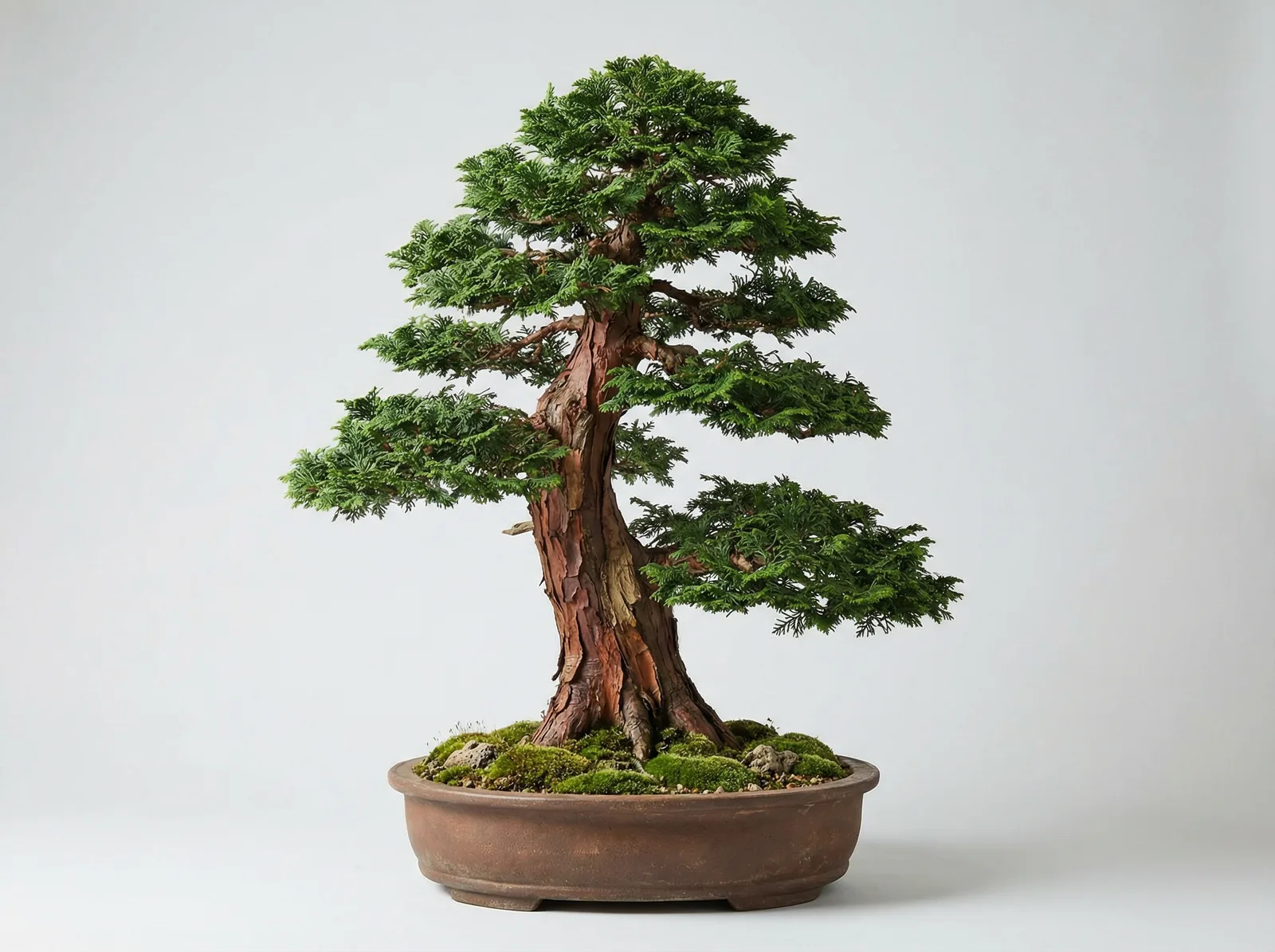
If you've ever seen a top-tier Japanese bonsai collection, you've seen hinoki cypress. Chamaecyparis obtusa 'Nana' produces fan-shaped sprays of scale-like foliage so perfectly textured they look sculpted from wax. Deep, dark green. Flat, layered pads. It's one of the most refined looks in bonsai, full stop. The wood carries cultural weight too -- hinoki is the timber of Shinto shrines and traditional Japanese soaking tubs.
The dwarf 'Nana' cultivar is practically engineered for bonsai work. Slow, compact growth. Natural pad formation. Reddish-brown bark that peels in thin strips on mature trees. Every trait works in your favor. One caveat comes with the slow growth: mistakes compound. You can't outgrow a bad cut the way you can with a juniper.
But there's one non-negotiable rule with hinoki: don't let it dry out. One missed watering and you'll have a permanent brown patch in the foliage. Hinoki foliage that dies doesn't come back. If you can commit to daily water checks -- twice daily in summer heat -- the reward is a tree with refinement that few species touch.
prune: spring, early summer (pinching); late winter (structure)
The routine
Water, water, water. It's the whole game with hinoki, because the species cannot recover browned foliage. Once a spray dries, it's dead forever. Not stressed. Not dormant. Dead. Check the soil every single day. In summer, check morning and evening. If you travel often or keep an erratic schedule, seriously consider a drip irrigation timer. It's cheap insurance against losing years of growth.
Light depends on where you live. Pacific Northwest or similar cool, overcast climates? Full sun, all day. Southeast or desert Southwest? Morning sun with afternoon shade, or you'll see browning at the branch tips. Watch the color -- healthy hinoki are a deep, saturated green. Yellowing tips mean too much heat or sun exposure.
Hinoki Cypress looking rough right now?Skip to common problems below, or start with the symptom guide.Winter is easy. Leave it outside. Protect the pot from hard freeze cycles in zones 5-6, but the tree itself is rock solid. Hinoki look gorgeous with a dusting of snow on those layered pads.
One more thing: hinoki foliage smells incredible. A warm, cedar-like fragrance you'll notice every time you prune. Some growers rank it as the single best thing about the species.
Shaping
Pinch, don't cut. That's the golden rule for hinoki foliage maintenance. Pull the tips of extending shoots with your fingers in spring and early summer. Scissors leave brown, crispy edges on the scale-like foliage that look terrible and take months to grow out. Finger pinching gives clean, natural breaks.
Thin the interior regularly. Hinoki drop any foliage that doesn't see light, so reach into the canopy periodically and remove downward-growing shoots, dead bits, and congested growth. You want air and light moving through those pads.
Do structural work in late winter. Remove crossing branches, straight-up shoots, and anything cluttering the design. Here's the critical thing: hinoki don't back-bud from bare, old wood. If you strip all foliage from a branch, that branch is finished. Always leave green on every branch you plan to keep.
The slow growth rate is a gift for pruning schedules. A well-maintained hinoki needs attention every few weeks in growing season, not daily like a tropical. You do the work and it holds the shape.
Every styling decision on a hinoki is permanent. The species will not back-bud from bare old wood, so a stripped branch is a finished branch -- style it the way you'd carve stone: plan twice, cut once, and always leave green on anything you intend to keep.
What you get in exchange is the most refined foliage in bonsai. Formal upright shows it off best: straight trunk, clearly separated tiers, each fan-shaped pad distinct and precisely shaped. Clear space between layers is what makes the style read.
Hinoki forests are the other showstopper. The uniform foliage texture unifies a group planting while varied trunk heights carry the depth -- a good hinoki grove stops foot traffic at shows.
Wire in spring or summer while wood is young and flexible; it turns brittle with age, and the thin bark scars fast, so check every three to four weeks and pull wire within four months. For gauge pairings, use /tools/wire-gauge.
Jin and shari are less common on hinoki than on juniper, but the reddish bark against bleached deadwood can work. Use these features sparingly -- hinoki look best refined and living, not loaded with deadwood.
When things go wrong
Brown foliage patches that won't come back. That's the big one. A single missed watering ruins more hinoki than every pest and disease combined. The foliage dies permanently when it dries. There's no fix, only prevention. Remove the brown sections cleanly with sharp shears so the tree redirects energy to what's left. One check before removing a whole branch: scratch the bark with a thumbnail. Green under the surface means the branch lives and only its dried sprays are lost; tan and dry means take it back to live wood.
Spider mites show up in hot, dry weather. Fine webbing and stippled, faded foliage are the signs. A strong water jet twice a week during heat waves keeps them from establishing; if they're already dug in, work through the treatment steps in our pest control guide (/guides/pest-control).
Phytophthora root rot hits when soil stays too wet for too long. The whole tree yellows gradually and just looks off. Good drainage prevents it. If you catch it early, repot into fresh, fast-draining 40/30/30 akadama/pumice/bark mix and cut away any brown, mushy roots.
Sparse, open foliage? Either the tree isn't getting enough light, or you haven't been pinching consistently. Move it somewhere brighter and start a regular pinching routine in spring. It won't fill in overnight, but it will fill in.
Garden centers sell Chamaecyparis obtusa 'Nana' and similar dwarf cultivars for $15-40 in 1-gallon pots. This is genuinely excellent bonsai starter material -- hard to go wrong at these prices. Hunt for specimens with dense foliage and interesting trunk movement. 'Nana Gracilis' and 'Kosteri' are also solid cultivar picks.
Online bonsai vendors offer pre-bonsai hinoki for $60-250. Evergreen Gardenworks carries quality stock, and specialty conifer nurseries are worth searching. Japanese imports with real trunk development run $200-500, but they'll save you a solid decade of grow-out time. If you're serious about the species, a Japanese import is money well spent.
Some links may become affiliate links; our picks don't change.
Also on the bench