Taxodium distichumoutdoor
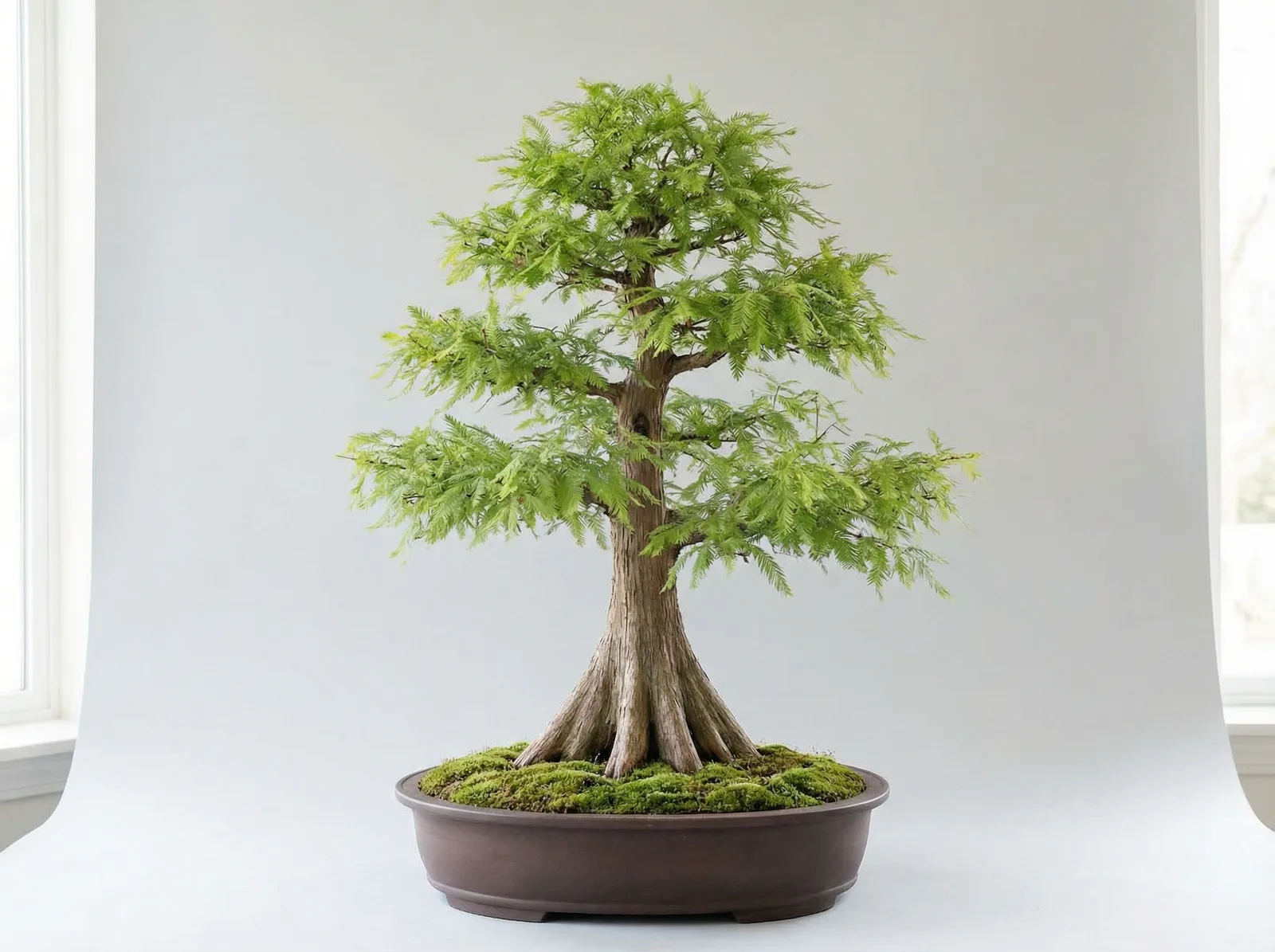
Bald Cypress Bonsai
- care
- intermediate
- light
- full sun
- zone
- 4–10
Metasequoia glyptostroboides · Cupressaceae
Why grow it
Dawn redwood was a fossil until 1941, when a Chinese forester walked into a valley in Hubei and found a grove of them growing. Every dawn redwood in cultivation descends from seed collected in that valley a few years later. The tree on your bench is a handful of generations removed from a species the world had already written off.
The backstory would be trivia if the tree weren't also the most forgiving conifer you can put in a pot. It runs a foot of growth in a season, buds back reliably on bare old wood, and fattens a trunk faster than any pine will. It is also deciduous: soft feathery foliage in spring, rust-orange in November, then bare fluted trunks all winter.
Where it earns its keep is group plantings. The natural habit is a straight trunk with strong taper, so a dozen seedlings set at staggered heights read as a real grove inside two or three seasons — see /styles/forest for the layout rules. Almost nothing else lets a first-year grower produce something that looks finished that quickly.
The routine
Sun and water are the whole program. Full sun all day, and a pot that never dries out. Get those two right and dawn redwood does the rest without much help from you.
The watering is genuinely demanding in July. Daily is the baseline, and on a windy 95°F afternoon a shallow pot can go through it twice. Standing the pot in a shallow tray of water through a heat wave is fine for this species — it is one of the few where a wet tray helps rather than rots. If you are new to reading a pot, /questions/how-often-to-water-a-bonsai covers the finger-and-chopstick method that replaces a fixed schedule.
Dawn Redwood looking rough right now?Skip to common problems below, or start with the symptom guide.Winter care is simple but non-negotiable. The tree must go fully dormant outdoors, and the pot must be insulated once nights drop below about 30°F — mulched in, buried, or shifted to a cold frame or unheated garage. Keep checking the soil through winter; a bare tree still drinks, just slowly. The seasonal routine is laid out in /guides/winter-care.
Feeding runs every 2 weeks from bud break to early September. Stop there. Late nitrogen pushes soft growth that a first frost turns to mush, and on a species this vigorous that is an easy mistake to make.
Shaping
Do the structural cutting in late winter while the tree is bare and the whole silhouette is visible. Big cuts heal quickly on dawn redwood, and it buds back from old wood far more reliably than most conifers, so you can be decisive about removing a branch that is in the wrong place.
Through the growing season, cut extending shoots back to two pairs of leaves once they push past the profile you want. Expect to do this three or four times between May and August — the tree simply grows that fast, and letting a shoot run for a month means an ugly stub later.
One quirk defines the species: dawn redwood puts out branches in near-perfect opposite pairs, which reads as artificial on a bonsai. Remove one of each pair as they form, alternating sides down the trunk. Do it early, while the branch is pencil-thin, and no one will ever know the tree does this.
The trunk also throws basal shoots and burls. Rub the shoots off unless you want a multi-trunk clump; the burls are part of the species' character and are better left alone than carved.
Formal upright is the honest style for this tree, and forest plantings are where it becomes genuinely spectacular. Odd numbers, one clearly dominant trunk, thinner trees toward the back and edges of the composition. Because the species grows so fast, a group started from $8 nursery liners looks like a landscape in three seasons.
Wiring is a light-touch business here. The bark is soft and marks easily, and young shoots are brittle at the base. Wire in late spring on shoots that have hardened slightly, keep the bends gentle, and pull the wire off after two months — dawn redwood thickens fast enough to swallow it. Size the wire to the branch with /tools/wire-gauge.
Most of the shaping should happen with the scissors instead. Directional cuts, letting a sacrifice leader run for a season to build taper, then cutting back hard in late winter. That clip-and-grow rhythm suits a species that back-buds this willingly, and it avoids scarring the bark.
What you are protecting is the base. The fluted, buttressed nebari is the signature of an old dawn redwood, so keep the surface roots radiating flat and resist burying the flare when you repot.
When things go wrong
A bare dawn redwood in January looks exactly like a dead one, which is the deciduous-conifer tax. Scratch a sliver of bark off a thin branch with a thumbnail: green and damp underneath means the tree is alive and dormant. Brown and dry means work back toward the trunk until you find green, and if the trunk itself scratches brown at the base, it is over. Test in a few places before you decide — /questions/is-my-bonsai-dead walks through the rest of the check.
Crisped, brown foliage in midsummer is a dry rootball, nearly every time. The damaged shoots will not green up again; cut them off, get the watering right, and the tree pushes replacements within weeks. If it happens twice in one summer, move the pot out of the wind or step up a pot size.
Yellow, weak growth in a well-watered tree usually means the pot has stayed soggy and the roots are suffocating. Dawn redwood wants wet, not stagnant. Check that water runs straight through when you water; if it pools on the surface, the mix has broken down and needs replacing at the next repot.
Spider mites turn up in hot, dry, sheltered spots and stipple the foliage a dull gray-green. A hard hose-down of the whole tree twice a week through a heat wave usually prevents them; /guides/pest-control has the treatment ladder if they are already established.
Spring frost damage looks alarming and rarely is. Blackened new shoots after a late freeze will be replaced from dormant buds — leave them until you can see where the new growth is coming from, then cut back to it.
Dawn redwood is one of the cheapest ways into decent bonsai material. Landscape nurseries sell 3-gallon whips for $25-45 in spring, and those trees already have the taper and the flared base that matter; you are buying five years of growth for the price of a pot. Look for a trunk that widens visibly at the soil line and has no reverse taper above a graft — the species is almost always grown on its own roots, so grafts are rare and worth walking away from.
Started bonsai run $60-150, and forest plantings of five to nine trees usually land between $120 and $300. Brussel's Bonsai carries dawn redwood regularly, including groups. Before you buy a group, count the trunks and check they are genuinely different thicknesses — a forest of identical trees never looks right, and no amount of later pruning fixes it.
Some links may become affiliate links; our picks don't change.
Also on the bench