Taxodium distichumoutdoor
Bald Cypress Bonsai
- care
- intermediate
- light
- full sun
- zone
- 4–10
Sequoia sempervirens · Cupressaceae
Why grow it
The tallest tree on earth is also, improbably, a decent pot subject. Sequoia sempervirens takes hard pruning, buds back from a lignotuber at the base, roots from cuttings, and grows fast enough that a nursery seedling becomes a convincing tree in a few seasons. The reduced foliage on a well-grown specimen looks like a miniature of the real thing in a way few conifers manage.
The honest catch is what it wants from your climate. This is a fog-belt species: cool, humid, bright, and never dry. In coastal California and the Pacific Northwest it is nearly carefree. In a hot inland summer or a dry apartment it is a slow disappointment, and no amount of misting substitutes for the conditions.
It is also sold constantly as an indoor bonsai, usually in a gift box with a redwood-forest photo on the lid. It is not an indoor tree. It wants outdoor light and a cool winter rest, and a warm living room delivers neither. Grow it on a shaded patio in zones 7-9 and it will reward you; grow it on a desk and you are running a slow experiment with a known result.
The routine
Think cool, bright, and damp. That single sentence covers most of what coast redwood asks for, and every common failure is a version of one of the three going wrong.
Watering is where most trees are lost. The rootball should never dry out — daily in summer, and a shallow tray of water under the pot during a heat wave is fine for this species specifically. Dry air makes it worse, so a sheltered corner with morning sun beats an exposed bench in wind. Through winter it stays evergreen and keeps drinking slowly; check the soil weekly and water when the surface has dried rather than following a set schedule.
Coast Redwood looking rough right now?Skip to common problems below, or start with the symptom guide.Heat is the enemy, not cold. Above about 95°F the foliage browns at the tips and the tree sulks for weeks. Afternoon shade from June onward in any hot-summer climate is not optional. In winter, shelter the pot once nights drop below about 28°F — the details of that routine are in /guides/winter-care.
Feeding is modest: every 3 weeks through the growing season, easing off after September. Heavy nitrogen produces the long, coarse juvenile foliage that makes a redwood look like a shrub instead of a tree.
Shaping
Coast redwood responds to cutting better than almost any conifer, which makes it forgiving to shape and easy to overwork. Structural cuts go in during late winter, before the growth flush, when you can see the trunk line clearly.
During the growing season, pinch or snip extending shoots back to the profile as they run. Doing this repeatedly is what converts the loose, open juvenile growth into the tight flat sprays that make the tree read as a redwood. Use scissors on the woody stem rather than pinching the soft tips, which browns the cut edge.
The lignotuber at the base constantly throws new shoots. Rub off the ones you do not want as soon as they appear, and keep one or two if you are building a multi-trunk group from a single tree — which, incidentally, is how redwood groves form in nature.
Avoid removing more than a third of the foliage at once. The tree will survive it, but it responds by pushing a mass of coarse juvenile growth from the base rather than refining what is left, and you lose a season getting back to where you were.
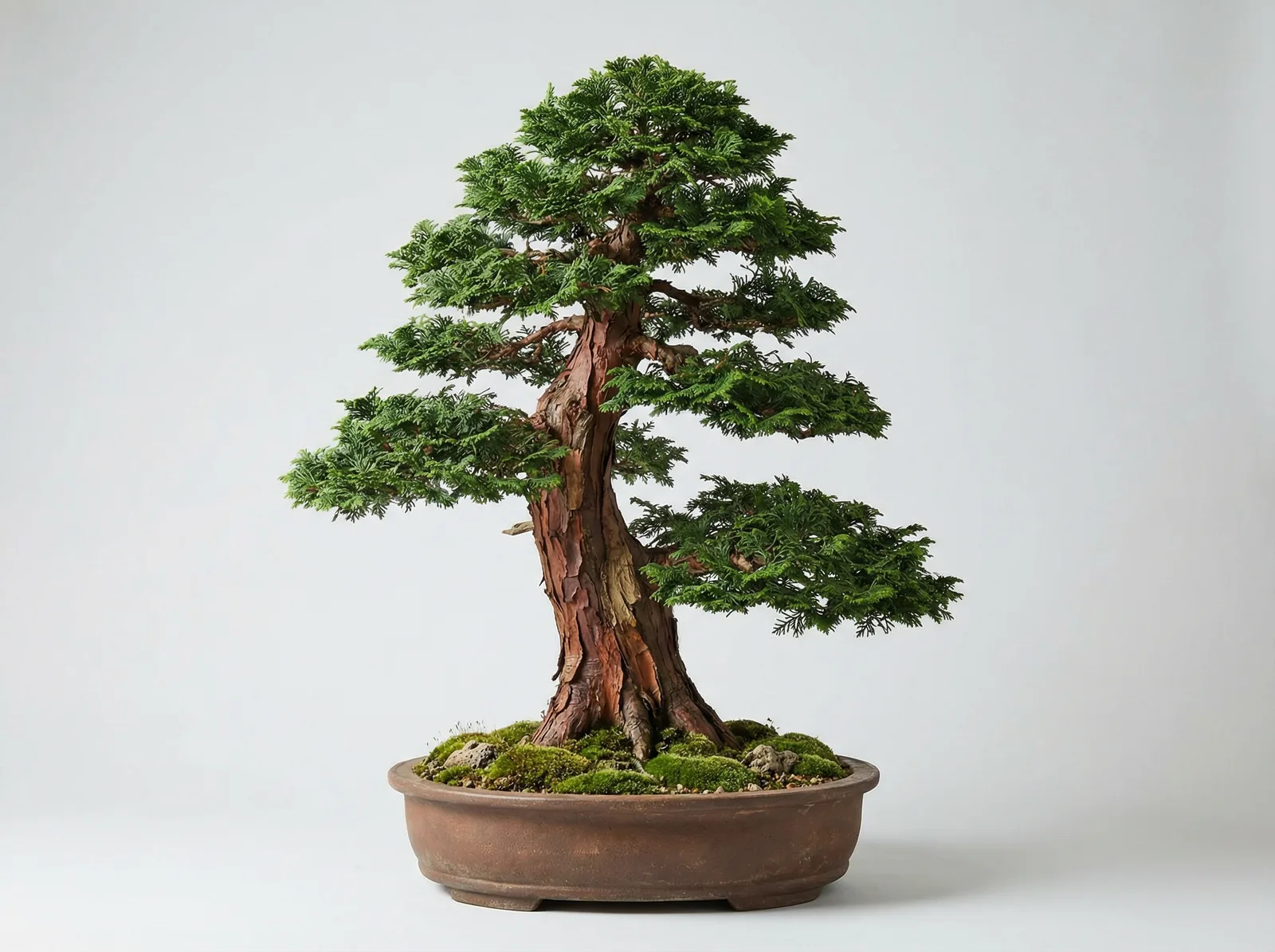
Formal upright with a straight, tapering trunk and horizontal branch pads is the style that tells the truth about this species. Old coast redwoods are columnar, branch-free for the lower third, with a slightly irregular crown — worth studying photographs before you cut anything.
Group plantings suit it even better than they suit most conifers, because redwoods genuinely grow in fairy rings of clones around a parent stump. Seven or nine trunks of varied thickness on a flat slab, close together, produces something no other species can do as honestly.
Wiring is possible but rarely the right tool. The bark is soft and fibrous and marks permanently under wire, and branches thicken fast enough to bite within a season. If you do wire, use aluminum on young shoots in late spring, pad anything larger, check every three weeks, and size it with /tools/wire-gauge. Guy wires anchored to the pot rim are safer for moving a heavy branch.
Most of the design work is clip-and-grow plus patience. Let a leader run to build taper, cut it back hard in late winter, select the new leader from the crop of shoots that follows, repeat. The species grows fast enough that this is a two-year cycle, not a ten-year one.
When things go wrong
Brown, crispy foliage tips are the signature complaint, and the cause is nearly always dryness — a rootball that went dry once, hot dry air, or both. Coast redwood does not recover a browned shoot; cut the damage off, fix the placement, and the tree replaces it. If a tree has gone fully brown, scratch the bark at the base of the trunk with a thumbnail. Green and moist means there is still a chance, and this species regenerates from the lignotuber even when the top is dead, so leave a scratched-green stump watered and shaded for a full season before giving up on it.
Sparse, stretched, ferny growth means not enough light. Juvenile foliage is long and flat; mature, compact foliage only develops in strong light with regular cutting back. Move the tree brighter and cut the loose growth back, and the sprays tighten within a season.
Yellowing throughout, on a tree that has been watered generously, points at a soil that has collapsed and gone airless. Redwoods want wet and aerated, which is a harder combination to hold than it sounds. Repot into a coarser mix at the next window.
Spider mites take hold in hot, dry, sheltered air and leave the foliage dull and stippled. Hose the whole tree down twice a week through hot weather as prevention; /guides/pest-control covers treatment for an infestation that has already set in.
Needle blight shows up in stagnant, humid air as brown patches spreading through the interior. Thin the crowded growth to open the canopy and improve airflow, and remove the affected shoots rather than trying to spray your way out of it.
Coast redwood is easy to find and easy to buy badly. The gift-shop version — a small tree in a glazed pot with an indoor-care card — is the same plant sold with the wrong instructions, and it usually arrives already stressed. Expect $20-40 for those and treat the tree as raw material rather than a finished bonsai.
Better material comes from West Coast nurseries selling 1- to 5-gallon landscape stock at $20-60. Look for a swollen lignotuber at the base and low branching, and check the foliage is a healthy blue-green rather than yellowed. Developed bonsai run $150-500, and group plantings usually more. Brussel's Bonsai stocks coast redwood regularly. Whatever you buy, ignore any tag that says indoor.
Some links may become affiliate links; our picks don't change.
Also on the bench